10 minutes

How to Find Purchase Mortgage Opportunity in Local Markets

January 31, 2026
How to find purchase mortgage opportunity blog thumbnail
Author:
Polygon Research

Identifying purchase mortgage opportunities in today’s lending environment requires more than competitive pricing and strong service standards. IMBs, Banks, Credit unions and fintechs increasingly need localized market intelligence to differentiate themselves and demonstrate value to real estate partners.

National trends and forecasts rarely explain why purchase volume grows in some communities and stalls in others. Effective strategy now depends on understanding how borrower behavior, product availability, affordability, and competition interact within specific local markets.

This framework was the focus of our recent Mortgage Data Fluency session, How to Find Purchase Opportunity in Local Markets. This article summarizes the analytical approach behind that discussion.

What Practitioners Are Experiencing in the Field

During the live session, we asked participants: “What is the biggest hurdle to proving your value to purchase mortgage partners?”

The most frequent responses were:

  • Standing out when most competitors emphasize “rates and service”
  • Delivering generic pitches that lack neighborhood-level specificity

The leading responses reflected two closely related challenges: differentiation and data depth.

When most lenders rely on similar messaging and surface-level metrics, real estate partners receive little actionable market insight and they tune out. Over time, this weakens professional relationships and limits referral opportunities.

Defining Purchase Opportunity in Mortgage Markets

In practical terms, every purchase mortgage opportunity reflects the alignment of three elements:

  • Households prepared to enter homeownership
  • Borrowers who qualify for financing
  • Loan products that meet financial and regulatory requirements

Sustained purchase activity emerges when these elements overlap within specific price tiers and geographies. When they diverge, volume becomes unstable regardless of broader economic conditions.

We define purchase opportunity as the measurable interaction between borrower readiness, product accessibility, and localized housing supply.

Understanding this interaction requires market segmentation and loan-level analysis.

Structuring Local Mortgage Market Segmentation

Local mortgage market segmentation refers to evaluating purchase activity by:

  • Borrower type and life stage
  • Income and employment profiles
  • Home price tiers
  • Submarket geography
  • Loan program utilization

Each segment responds differently to changes in rates, inventory, and affordability. First-time buyers, repeat purchasers, and government-loan borrowers exhibit distinct demand patterns.

Without segmentation, these differences are absorbed into aggregate statistics that obscure market structure.

Effective local mortgage market analysis isolates these segments and evaluates their relative contribution to demand.

Loan Product Mix and Borrower Behavior

Loan programs provide insight into borrower constraints and preferences.

For example, FHA lending often reflects affordability pressure and entry-level demand; VA utilization highlights mobility among military households; USDA activity signals rural and semi-rural opportunity; and Conventional lending reflects higher credit and income profiles.

Tracking changes in loan product mix helps explain how borrower behavior evolves across economic cycles.

This form of borrower behavior analysis supports more accurate planning and more targeted partner engagement.

Limitations of Generic Market Intelligence Platforms

Many technology platforms describe themselves as providers of mortgage market intelligence. In practice, these solutions frequently emphasize narrow functions such as:

  • Recruiting databases
  • Lead-generation systems
  • Pre-packaged market reports
  • Static performance rankings

These tools provide information but rarely support analytical reasoning.

They often present conclusions without transparent methodology, suppress variation through aggregation, and limit market-specific interpretation.

Our recent discussion of data privacy and market intelligence addresses related concerns about transparency and accountability in analytical systems.

Using Local Market Data for Opportunity Identification

Reliable purchase lending strategy depends on granular, auditable data.

Loan-level mortgage records, demographic information, and housing market indicators allow analysts to examine:

These insights translate into emerging demand patterns, localized and in context, which enables richer conversations between housing finance partners such as loan officers and real estate agents.

Our work with loan-level and microdata analysis reflects this approach.

Market Intelligence as an Organizational Capability

Market intelligence functions most effectively as an internal capability rather than a reporting product.

Institutions that invest in defensible market analysis are better positioned to:

  • Allocate resources efficiently
  • Align product offerings with demand
  • Support loan officers with localized context
  • Evaluate competitive positioning
  • Document strategic decisions

This perspective aligns with our foundational work on defining mortgage market intelligence. It also builds upon our experience evaluating market intelligence tools.

Translating Analysis Into Operational Strategy

Analytical insight creates value when it informs operational decisions.

High-performing organizations use market intelligence to:

  • Prioritize geographies and borrower segments
  • Customize outreach and partner engagement
  • Align staffing models
  • Adjust pricing strategies
  • Maintain consistent market monitoring routines

These practices support data-driven purchase lending without reliance on speculative forecasting.

Watch the Session On Demand

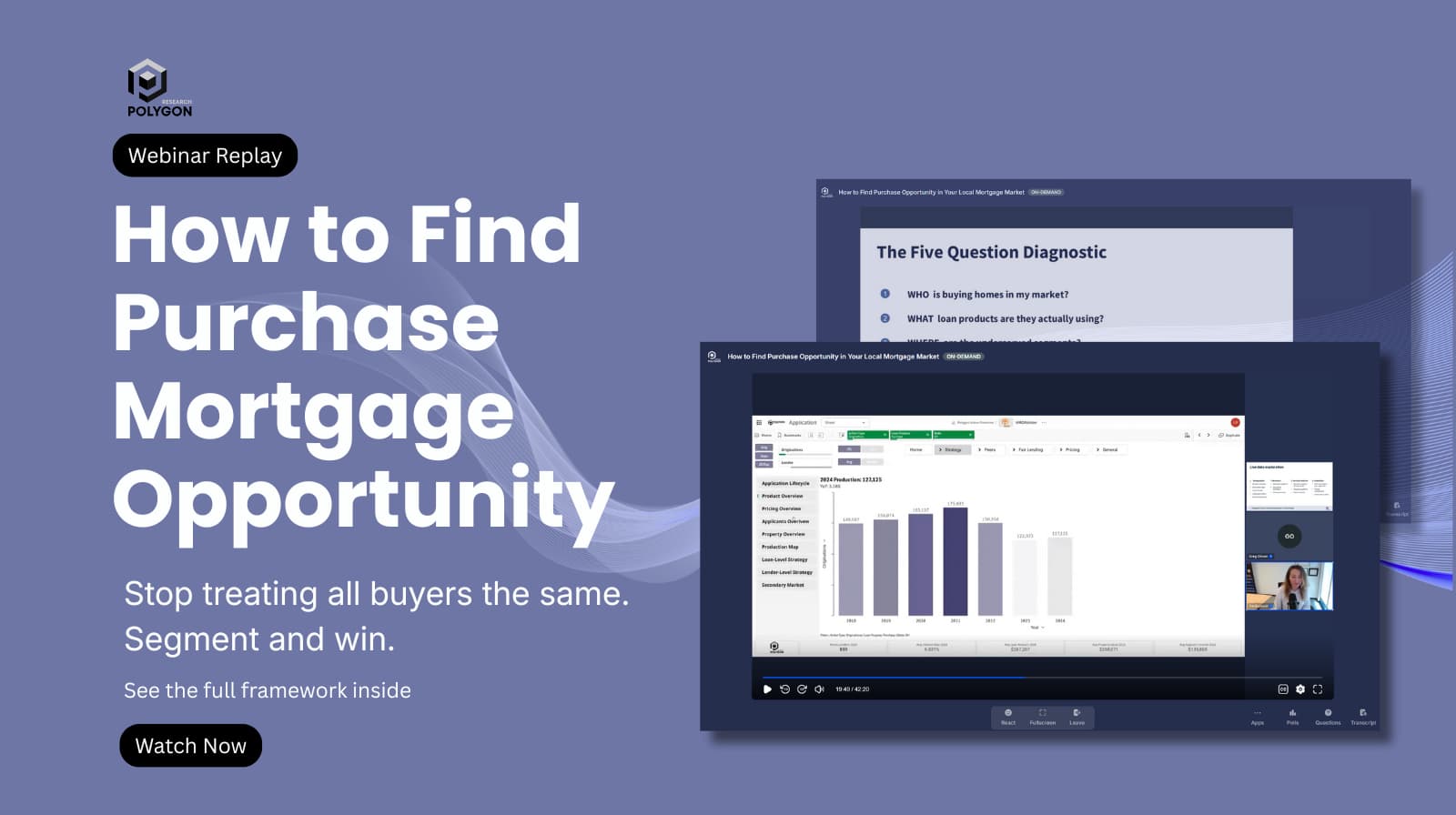
The full session, How to Find Purchase Opportunity in Local Markets, is available on demand.

The recording demonstrates:

  • Local market segmentation techniques
  • Interpretation of loan-level data
  • Identification of emerging demand patterns
  • Construction of repeatable analytical workflows

Watch How to Find Purchase Opportunity in Local Markets
Conclusion: Building Sustainable Market Understanding

Sustained success in purchase lending depends on institutional market understanding.

Systems that prioritize transparent methodology, defensible data, and analytical discipline strengthen long-term strategic capacity. Tools that oversimplify markets weaken it.

Mortgage Data Fluency reflects Polygon Research’s commitment to building durable analytical capability through education, transparent data, and practical frameworks.

Register for our upcoming events here.

How to Find Purchase Mortgage Opportunity in Local Markets

Learn how mortgage lenders and credit unions can identify purchase mortgage opportunities using local market data, borrower segmentation, and transparent market intelligence. Understand how disciplined analysis supports sustainable purchase lending growth.

How to find purchase mortgage opportunity blog thumbnail

Identifying purchase mortgage opportunities in today’s lending environment requires more than competitive pricing and strong service standards. IMBs, Banks, Credit unions and fintechs increasingly need localized market intelligence to differentiate themselves and demonstrate value to real estate partners.

National trends and forecasts rarely explain why purchase volume grows in some communities and stalls in others. Effective strategy now depends on understanding how borrower behavior, product availability, affordability, and competition interact within specific local markets.

This framework was the focus of our recent Mortgage Data Fluency session, How to Find Purchase Opportunity in Local Markets. This article summarizes the analytical approach behind that discussion.

What Practitioners Are Experiencing in the Field

During the live session, we asked participants: “What is the biggest hurdle to proving your value to purchase mortgage partners?”

The most frequent responses were:

  • Standing out when most competitors emphasize “rates and service”
  • Delivering generic pitches that lack neighborhood-level specificity

The leading responses reflected two closely related challenges: differentiation and data depth.

When most lenders rely on similar messaging and surface-level metrics, real estate partners receive little actionable market insight and they tune out. Over time, this weakens professional relationships and limits referral opportunities.

Defining Purchase Opportunity in Mortgage Markets

In practical terms, every purchase mortgage opportunity reflects the alignment of three elements:

  • Households prepared to enter homeownership
  • Borrowers who qualify for financing
  • Loan products that meet financial and regulatory requirements

Sustained purchase activity emerges when these elements overlap within specific price tiers and geographies. When they diverge, volume becomes unstable regardless of broader economic conditions.

We define purchase opportunity as the measurable interaction between borrower readiness, product accessibility, and localized housing supply.

Understanding this interaction requires market segmentation and loan-level analysis.

Structuring Local Mortgage Market Segmentation

Local mortgage market segmentation refers to evaluating purchase activity by:

  • Borrower type and life stage
  • Income and employment profiles
  • Home price tiers
  • Submarket geography
  • Loan program utilization

Each segment responds differently to changes in rates, inventory, and affordability. First-time buyers, repeat purchasers, and government-loan borrowers exhibit distinct demand patterns.

Without segmentation, these differences are absorbed into aggregate statistics that obscure market structure.

Effective local mortgage market analysis isolates these segments and evaluates their relative contribution to demand.

Loan Product Mix and Borrower Behavior

Loan programs provide insight into borrower constraints and preferences.

For example, FHA lending often reflects affordability pressure and entry-level demand; VA utilization highlights mobility among military households; USDA activity signals rural and semi-rural opportunity; and Conventional lending reflects higher credit and income profiles.

Tracking changes in loan product mix helps explain how borrower behavior evolves across economic cycles.

This form of borrower behavior analysis supports more accurate planning and more targeted partner engagement.

Limitations of Generic Market Intelligence Platforms

Many technology platforms describe themselves as providers of mortgage market intelligence. In practice, these solutions frequently emphasize narrow functions such as:

  • Recruiting databases
  • Lead-generation systems
  • Pre-packaged market reports
  • Static performance rankings

These tools provide information but rarely support analytical reasoning.

They often present conclusions without transparent methodology, suppress variation through aggregation, and limit market-specific interpretation.

Our recent discussion of data privacy and market intelligence addresses related concerns about transparency and accountability in analytical systems.

Using Local Market Data for Opportunity Identification

Reliable purchase lending strategy depends on granular, auditable data.

Loan-level mortgage records, demographic information, and housing market indicators allow analysts to examine:

These insights translate into emerging demand patterns, localized and in context, which enables richer conversations between housing finance partners such as loan officers and real estate agents.

Our work with loan-level and microdata analysis reflects this approach.

Market Intelligence as an Organizational Capability

Market intelligence functions most effectively as an internal capability rather than a reporting product.

Institutions that invest in defensible market analysis are better positioned to:

  • Allocate resources efficiently
  • Align product offerings with demand
  • Support loan officers with localized context
  • Evaluate competitive positioning
  • Document strategic decisions

This perspective aligns with our foundational work on defining mortgage market intelligence. It also builds upon our experience evaluating market intelligence tools.

Translating Analysis Into Operational Strategy

Analytical insight creates value when it informs operational decisions.

High-performing organizations use market intelligence to:

  • Prioritize geographies and borrower segments
  • Customize outreach and partner engagement
  • Align staffing models
  • Adjust pricing strategies
  • Maintain consistent market monitoring routines

These practices support data-driven purchase lending without reliance on speculative forecasting.

Watch the Session On Demand

The full session, How to Find Purchase Opportunity in Local Markets, is available on demand.

The recording demonstrates:

  • Local market segmentation techniques
  • Interpretation of loan-level data
  • Identification of emerging demand patterns
  • Construction of repeatable analytical workflows

Watch How to Find Purchase Opportunity in Local Markets

Conclusion: Building Sustainable Market Understanding

Sustained success in purchase lending depends on institutional market understanding.

Systems that prioritize transparent methodology, defensible data, and analytical discipline strengthen long-term strategic capacity. Tools that oversimplify markets weaken it.

Mortgage Data Fluency reflects Polygon Research’s commitment to building durable analytical capability through education, transparent data, and practical frameworks.

Register for our upcoming events here.

Learn more

Frequently asked questions

What Insights Does Polygon Research Provide on First-Time Homebuyers (FTHBs)?
Polygon Research provides comprehensive, loan-level intelligence on First-Time Homebuyer (FTHB) activity across the U.S. mortgage market. Our platforms combine public mortgage, housing, and demographic data to help lenders, credit unions, policymakers, and analysts understand where first-time buyers are entering the market, how they are being served, and what barriers they face.
What Is a First-Time Homebuyer (FTHB)?
A First-Time Homebuyer (FTHB) is generally defined as a person who is purchasing a primary residence and has not owned a home in the past three years. However, the exact definition varies depending on the data source, program, or analytical framework being used. At Polygon Research, we use a data-driven, transparent definition that aligns with how first-time buyers actually appear in mortgage and housing market data.
What kinds of questions can CensusVision answer?
CensusVision answers questions about who lives in a community, how households form, what housing they occupy, what they can afford, and where unmet demand or structural barriers exist.
What is HMDAVision?
HMDAVision is a loan-level mortgage analytics application built on HMDA data. It helps professionals analyze lending activity, borrower outcomes, pricing, competition, and fair lending signals using transparent, explainable views rather than rankings or black-box scores.
What kinds of questions can HMDAVision answer?
HMDAVision is designed for real analytical questions—such as who is borrowing, how borrowers are priced, where competition exists, and where outcome differences may warrant review. It supports redlining, underwriting, pricing, and marketing analysis using controlled, loan-level views.

Explore Mortgage Market Intelligence in Practice

See how Polygon helps teams grow through insight.