Where can we grow?
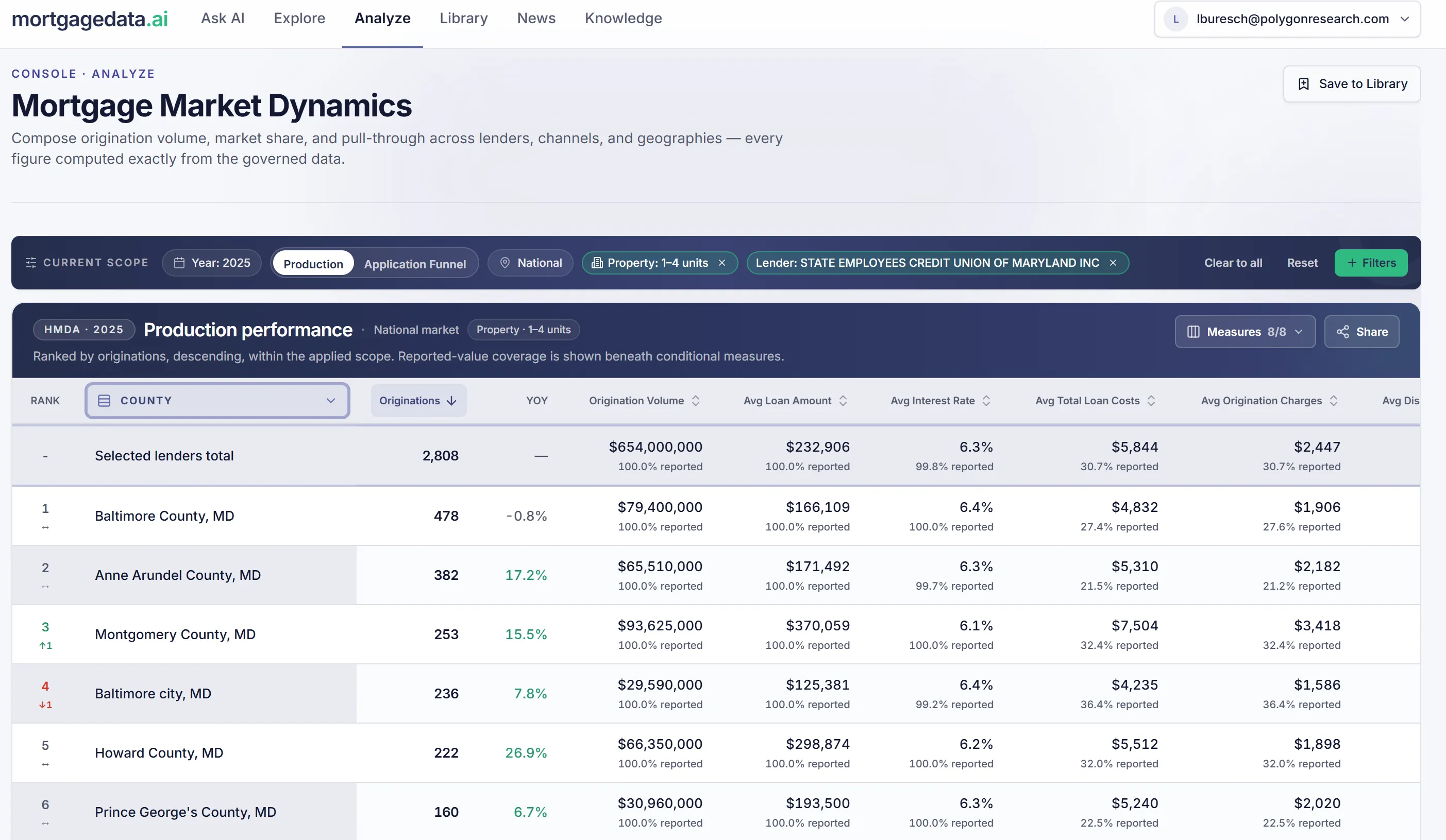
Evaluate counties, neighboring states, borrower segments, housing demand, competitor strength, branch coverage and field-of-membership fit.
Mortgage market intelligence for credit unions
Polygon Research helps credit union teams connect their own performance with the mortgage and housing markets around their members. The work begins with a decision, then brings together the evidence needed to examine it clearly.
Evaluate counties, neighboring states, borrower segments, housing demand, competitor strength, branch coverage and field-of-membership fit.
Explore first-time buyers, repeat buyers, home equity, renovation, affordability and members whose first mortgages are held elsewhere.
Compare portfolio lending, loan sales, servicing, liquidity, duration and peer institutions following similar mortgage strategies.
Give mortgage, finance, risk, fair lending, marketing, branch and community teams a shared market view and practical questions to pursue.
A concise view of market scale, product mix, lender activity, and borrower outcomes—grounded in 2025 HMDA analysis.
Credit unions originated 1,003,176 mortgage loans in 2025—representing 14.7% of the U.S. market and approximately $212 billion in volume.
Navy Federal Credit Union led with 80,547 originations. GreenState Credit Union and Idaho Central Credit Union recorded some of the strongest growth among the top ten.
Home-improvement and purchase lending were nearly even, followed by other-purpose lending, cash-out refinancing, and rate-and-term refinancing.
Conventional conforming mortgages and HELOCs account for most credit union mortgage activity. The mix varies meaningfully by institution, market, and balance-sheet strategy.
Approval rates become more useful when viewed by borrower characteristics, product, geography, application stage, and peer group. Aggregate rates alone can conceal important operational and fair-lending questions.
The answer may be a product, borrower segment, county, member group, distribution channel, or balance-sheet strategy. Connected local and institutional data helps narrow the opportunity to what the credit union can serve credibly and sustainably.
A dashboard can surface an answer. A capable team knows which question to ask next.
Polygon Academy helps mortgage, finance, risk, marketing, branch, and community teams develop a shared language for housing and mortgage data. Practical learning turns reports into better conversations, stronger analysis, and decisions that travel across the institution.
Learn how mortgage, housing, borrower, and institutional datasets fit together, and where each source has limits.
Move from a headline metric to the product, geography, peer, borrower, and operational questions behind it.
Give leaders and member-facing teams a common evidence base for strategy, communication, and follow-through.

