S2 E4
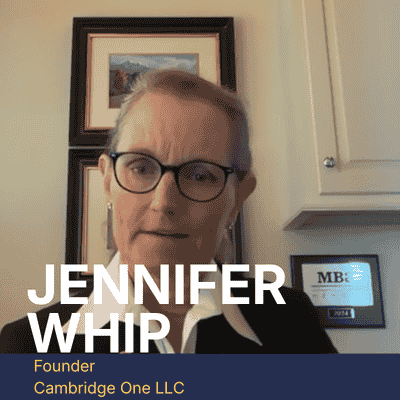
From Fannie Mae to Founder with Jennifer Whip
Show Notes
Val Buresch delves into the inspiring journey of Jennifer Whip, CMB, a leader who embodies courage and reinvention. From a distinguished career at Fannie Mae to founding her own consulting firm, Jennifer shares her story of taking calculated risks, the importance of networking, and the personal wake-up calls that shaped her path. Discover how mentorship and continuous learning play pivotal roles in her success, and gain insights into the evolving mortgage industry. Tune in for a conversation filled with wisdom, personal anecdotes, and a look at the future of entrepreneurship.
Transcript
Introduction
Val Buresch: Welcome to CMB Connect. I'm your host, Val Buresch, and on this show, we don't just talk about the achievement—we explore the journey, the mindset, the person behind the designation. Today we are doing this with an amazing leader in our industry, Jennifer Whip, who started a career with Fannie Mae, one of the iconic and most important institutions in our industry, and decided along the way that it was time for her to start her own journey as an entrepreneur, as a founder of a company. Jennifer, I'm very excited to have you on this show. Thank you so much for being here to share your story with us.
Jennifer Whip: Thank you for having me. I'm looking forward to it.
________________________________________
Early Career Path
Val: Before we dive into this entrepreneurship chapter of your career, I want to ask you: what drew you first to the mortgage banking industry?
Jennifer: I came to Pennsylvania from California to go to grad school at Villanova University, and I needed a job during the day. So I applied for a job at a bank and started as a teller. The lady who ran the mortgage department used to come in and make deposits, and I always asked a lot of questions. I developed a relationship with her and she said, "Why don't you give mortgage a shot?" So I transitioned to the mortgage department—it sounded like fun. I worked in the origination space for a couple of years.
When I finished my MBA, the head of the mortgage department came to me and said, "What do you want to do next?" I said I really wanted to get into trading—I wanted to go to Wall Street. He said, "What if I could give you a job similar to that and you could stay at the bank?" I was open to ideas, though I did continue to interview on Wall Street. But he made me a very good offer, so I transitioned into the secondary market area and started trading and hedging.
That led to developing a relationship with Fannie Mae. Through a few transitions, one thing led to another. My boss for many years at Fannie Mae reached out and asked if I'd be willing to apply for a job there. I wasn't so sure I wanted to work at Fannie Mae—I loved the origination side. But he convinced me after the interview that it would be the best place for me to go. So I took the job and worked at Fannie Mae for 26 years.
________________________________________
Life at Fannie Mae
Val: Can you elaborate a little bit more for us? What was your primary role at Fannie Mae? What was the project or accomplishment that you were most proud of?
Jennifer: I always tell people the last job I had at Fannie Mae was the best job at Fannie Mae. I was responsible for business development, having managed customers of all sizes. I got the opportunity to take over responsibility for the smallest lenders—that amounted to about 1,200, maybe not quite that many active, but about 1,000 active lenders across the nation: credit unions, banks, mortgage companies. I managed all of the trade organizations, the HFAs, two call centers. And I did a lot of speaking out in the industry across the nation, along with my team.
It was a wonderful job. I solved problems for people. When things came to me, it was usually because something was stuck. I really took it very personally to make sure that each of my customers had a good experience. It wasn't always under positive circumstances, but I thought the least I could do is make this good for the people that are counting on me. So I tried to make myself accessible and really be empathetic toward customers and the circumstances they're dealing with. It was a dream job. I loved it.
I actually said to my fiancé at the time, who's been my husband now for 35 years, "I'm never leaving"—because I loved Fannie Mae. I had a wonderful career, and Fannie Mae was very good to me.
________________________________________
The Decision to Leave
Val: That's a great story. But can you tell us how you went from "I'll never leave" to actually making that leap?
Jennifer: That takes me to the transition—because how does one leave a dream job and do something different? It was a very personal decision. I had a college friend pass away suddenly. She was 55 years old, and it was a wake-up call for me. I thought, "I have poured myself into this job." It is a seven-day-a-week job, and I lived on American Airlines. I was flying three days a week and traveling all around. Again, it sounds very glamorous, but honestly, it kept me from doing things that I still had not experienced in life.
When my friend passed away, it jolted me into realizing I needed to spend more time with my family. I needed to check off some more bucket list items. So I ran the numbers, said, "Okay, I think I can make this work," and went into my boss's office. I was sort of hoping he would beg me to stay, and he didn't. Then I realized that this was real—that I had now committed myself to something that was a really big change.
The good news is I had about six months before I actually left the company, so it gave me some time to really think about what I wanted to do next.
Val: Was there also a connection to your father in this decision?
Jennifer: Yes, there's another personal element to this. My dad was self-employed. When I got my MBA, I had every intention of going back home and working with my dad in his business. Unfortunately, he fell victim to an accident—it was a really tragic thing. So I lost my dad at a young age.
But my dad was very important to me in the sense that he gave me really high values and ethics. I literally tell people my dad is sitting on my shoulder every time I make a decision: "What would my dad do?" When my friend passed away many years later, there was something nagging at me. My dad always said, "Work for yourself." And here I had been in this wonderful career that I absolutely loved. But had he lived, I often wondered if he would have said, "What are you doing working for this big company? You should go and work for yourself."
That in itself was a bucket list item for me—that I was able to wake up one day and say, "Dad, I'm doing it." It was very emotional to get to that point and find out that I could actually do it.
________________________________________
The CMB Designation
Val: Is this the time when you decided it was time to get your CMB, or did you get your CMB before?
Jennifer: Great question. I left Fannie Mae in April of 2016, and almost simultaneous with leaving, I signed up for what I think was the June class. So it was almost immediately after. When I thought about it, I thought, "This is something I always wanted to do for myself and I never felt like I had the time."
Not knowing how my career would go from here, I thought it was an opportunity for me to achieve something just for myself. I wanted to see if I could do it. I had a fabulous foundation of experiences going into the CMB program, but I had no idea how much I would learn. It was an amazing experience. I chuckle about it because I thought, "I've worked at Fannie Mae. I touched everything." No way. There was so much I didn't know.
Val: Did you feel like you were joining another community? Because sometimes when you're an entrepreneur, things can get a little lonely day to day.
Jennifer: Absolutely. When you go into consulting, what was not clear to me was once you pick a plan on what you're going to cover, there's a whole community of consultants and industry participants that complement one another. Right off the bat, I got a lot of referral business from other consultants that didn't have the expertise where I did. I realized that there was a whole network of consultants that refer business to each other.
I can't emphasize this enough: I grew up in a different generation where the whole idea of social media and networking—even mentoring—was not something I really took seriously until later in my career when I realized it was essential. I felt like there was an aspect of "I'm relying on other people, other people are relying on me, and I need to make sure that I'm fully invested in them."
Going into the CMB, even though I went into this intending to sort of check a box for myself, I had no idea how valuable it would be for me in giving back to other people and finding relationships. Now I feel like I can call almost any CMB for any question that I have, and I know they're going to answer it for me. And the same for me—if a CMB reaches out to me, I'm taking that call because I know that person is important and they need something and I've got to be there to help them.
It's a wonderful network of people that I think really get the idea that it's not a one-way street. It's a two-way relationship. I didn't fully appreciate that until I was older, and now I totally get it.
________________________________________
Advice for Those Considering a Career Change
Val: Speaking of wisdom, for other mortgage professionals who might be thinking of leaving a safe job, what is the single most important piece of advice that you could offer them?
Jennifer: Get feedback from other people. Rely on your network to give you feedback. Whenever you make a change in life—whether it's just a job change or unfortunately you are losing your job because of a reduction in force—what you'll find is the people you think will help you are not always the case. So the people you think you're going to need won't always be there for you, but others will emerge, and you have to be open to those new relationships.
What I discovered when I made my transition was people came out of the woodwork to help me. But it takes that invitation—going and finding people and asking questions. Start by asking questions and gain insight from people. Don't immediately go in looking for a job or a client, but go find out what people think is needed out there.
When I started that six-month journey transitioning from Fannie Mae to starting my own business, I said to people, "What do you think I should do? What do you think is needed out there?" It became clear very, very quickly. Most people came back with exactly the same answer, which is what I do. So I relied on people to help guide me. These were people I trusted. They weren't giving me a job or finding me a client—they were giving me good advice on how to be successful.
Then whenever I needed something—something silly like "How do I get a tax ID? How do I set up a company?"—I just started calling other consultants and saying, "How did you come up with contracts?" It was amazing the amount of support that one can get by just asking a few questions and then being open to providing that same support on the other side.
________________________________________
Cambridge One: The Business
Val: Let's talk about what you created—Cambridge One, your company. Tell us first of all, what's the concept? What services do you provide? And I'm very interested: how did you come up with the name?
Jennifer: Let me tell you, I had a different idea of what I would do in my career when I started this company. I started running the idea by people, and without going into what that was, most of my customers and clients at the time said, "No, no, no. No one's going to pay you for that. What people really need is for you to help them get Fannie Mae approval or Freddie Mac approval."
I said, "Well, that's something I know really well, but that doesn't seem like a business." And people said, "You would be surprised. People are nervous about applying. They're anxious. They don't have the facts. It's daunting to take this on, just like any new relationship, and you could help them hold their hand."
I thought, "Okay, this will pay the bills. Let me do a couple." And gosh, it's been—I'm coming up on 10 years, and I've helped well over 300 lenders get their approvals in that time. A lot of what came to me was word of mouth from former customers that had gotten approved. I want to give a shout-out to various organizations that gather lenders—collaboratives and cooperatives and MBA conferences. People talk, and that's where a lot of my business comes from: from former clients that say, "Hey, call Jennifer. She'll help you."
So that's what I've been doing. I did a few other things along the way, but I primarily help lenders get prepared to submit their applications to Fannie Mae and Freddie Mac.
Val: How long does it take to get approved? How long is that process?
Jennifer: That has changed a lot over the last nine years. What I can happily say is I think both Freddie Mac and Fannie Mae are making nice improvements to the process that are shortening it a good bit. Generally, I tell a lender you want to take a few months and gather documentation, make sure your ducks are in a row. You want to have all of the information.
By the way, any lender can do this on their own—they don't need to hire me. What I do is I make it a clearer path, perhaps. But both Fannie Mae and Freddie Mac offer a lot of materials online. You have to find them and then read them and gather all the documentation. I wouldn't recommend somebody go in blindly and apply because I think they're going to find out along the way that they need a lot more information than they might have anticipated.
Getting organized may take three to six months, depending on the institution. And then the application process should take about 90 days once in-house for each of them.
Val: Now, the name—you didn't answer my question about Cambridge One!
Jennifer: So I was trying to come up with a name for a company, and at the time, this was during Kate Middleton getting married to Prince William and she was becoming the Duchess of Cambridge. Well, my husband thinks the Duchess of Cambridge is lovely on every level. He admired the Duchess of Cambridge, and I thought, "Well, maybe I should create a company with the name Cambridge in it, and then I can get business cards drawn up that say Duchess, so I can be the Duchess of Cambridge."
Obviously, I did not do that. In searching around in the state of Pennsylvania for names that were available, I ended up with Cambridge One. So we jokingly call my car the Duchess of Cambridge, and I'm going to "take the Duchess to the grocery store," but I am not the Duchess of Cambridge.
________________________________________
Looking Ahead
Val: So what's next for you, Jennifer, and for your company? What are you most excited about for the future of Cambridge One and for the mortgage banking industry in general?
Jennifer: First of all, like so many people in this industry, I love this business. I joke about it when I'm around other people. You go to a neighborhood party and tell people you're in the mortgage business—they either want to know where interest rates are going or they walk away as fast as they can because they don't want to talk about mortgages. So the mortgage people tend to hover around the chip bowl and share stories and get along.
But what people from the outside fail to realize is what a fun business this is. Every day of every year that I've been in this industry, I've learned something. Just about the time you think you understand something, someone will explain that you don't understand it. It's one of the reasons I stay active in the CMB Society—because I'm constantly getting the opportunity to stay fresh and learn something new, or I have to go look something up because I don't know the answer.
It's a fun business filled with a lot of really fun people that are smart. I think we all challenge each other every single day. I think we are very fortunate in the United States to have the residential mortgage industry that we have. When you travel around the world, we are the envy of the world in what we do. And we play an extremely important role.
I've believed that from the day I started in this industry. So I think the future is—hopefully we will continue to evolve and change in positive ways and not return to bad times. We've gone through the credit crisis. I hope we've learned from that and that we never return there because that was really challenging.
But we have an opportunity with generative AI, with technology, things becoming simpler, and big data. There are all kinds of opportunities in this industry, but it will always be a people business. I believe that it's important for us to remember that we're talking about people's lives, their biggest investment or the start of their investment portfolio—owning a home. It comes down to being personal. And that personal touch is always going to matter, even though someone may apply for a loan online. Ultimately, I believe they're going to have to touch people and have a good experience.
That's what I see ahead for the industry, and I'm excited about it. For Cambridge One, I'm going to keep doing this for a little bit longer, and we'll see what happens there. I'm not going to rule out the idea that there's a chapter three at some point. What form that might take? I'm not completely sure. It may involve a little bit more golf, but we'll see. I haven't mastered the art of playing golf yet, so I've still got some work to do there.
But for the time being, I'm enjoying what I'm doing and I'll be at it for a little bit. I certainly hope to continue being involved with the CMB Society. It's been an absolute pleasure.
________________________________________
Closing
Val: Jennifer, thank you so much. I just want to mention that if anyone wants to learn more about you or your work, they should go to your website, cambridgeone.net, and LinkedIn. Thank you so much for spending this time today with us on CMB Connect. I will see you in the CMB Society.
Jennifer: Thank you. Look forward to it, Val.
Val: Thank you for listening. Don't forget to follow us, and see you next time.
________________________________________
About the Guest: Jennifer Whip is the founder of Cambridge One, a consulting firm that helps mortgage lenders obtain Fannie Mae and Freddie Mac approvals. With 26 years at Fannie Mae and nearly 10 years running her own business, she has helped over 300 lenders navigate the approval process.
Connect with Jennifer:
• Website: cambridgeone.net
• LinkedIn: Jennifer Whip
About CMB Connect: CMB Connect explores the journeys of Certified Mortgage Bankers, diving into the stories behind their success and the wisdom they've gained along the way.
