S3 E4
Dream Big, Practice Gratitude and Keep Climbing
Show Notes
What does a correspondent lender do for banks and credit unions?
A correspondent lender buys closed mortgage loans from banks, credit unions and independent mortgage bankers. Margaret Chiavini, CMB, explains that this gives lenders liquidity after they fund a loan and can also expand the range of products they can offer their customers and members.
What do banks and credit unions look for in a correspondent lending partner?
Margaret says three concerns come up repeatedly: whether the products add value for customers and members, whether those borrowers will be well cared for through servicing, and whether they will be protected from unwanted cross-selling. The quality of the ongoing partnership matters as much as the transaction itself.
How can the CMB designation change the way a mortgage professional approaches the business?
For Margaret, earning the Certified Mortgage Banker designation made her work more intentional. The process helped her see how the different parts of mortgage banking fit together, strengthened her professional network, and made her more aware of both what she knew and what she still had to learn.
What leadership practices helped Margaret's team grow?
Margaret describes beginning each week by recognizing wins, then focusing on what the team needs to accomplish, where support is needed and how team members can encourage one another. She says the bank and credit union division grew from a little under $5 billion a year to about $15 billion a year over five years, supported by the broader Newrez organization and its customers.
What advice does Margaret give people entering or advancing in mortgage banking?
She recommends understanding the purpose of the industry, focusing on possibilities rather than only on market challenges, finding a mentor and building a strong professional network. Her broader message is that difficult goals often become the most rewarding accomplishments.
About this episode
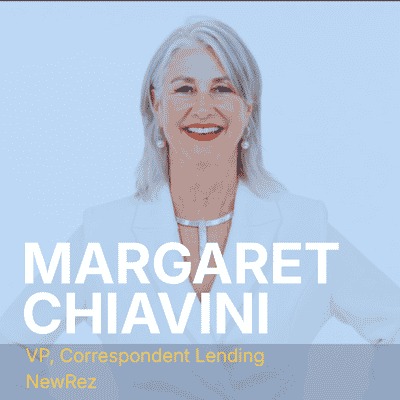
Margaret Chiavini, CMB, leads Newrez's National Bank and Credit Union Division. In this CMB Connect conversation, she discusses correspondent lending, the CMB journey, team leadership, perseverance, gratitude and the thinking behind her book It's Your Party.
Transcript
Margaret Chiavini, CMB (00:00)
Some of the lessons that I learned were that perseverance, you know, you you can't give up. So you have to just have that goal steady in front of you, and it's the calm as you pursue that. My mother used to say that never take your eye from the goal, nor disturb the calm with which you pursue it.
Val Buresch, CMB (00:26)
Welcome
to CMB Connect. I'm Val Buresch, a CMB and a past chair of the CMB Society. And on this podcast, we get to know the people behind the CMB designation and the work they do across the mortgage industry. And today I'm joined by Margaret Chiavini, a CMB, who leads NewRez's National Bank and Credit Union Division. Margaret
brings a remarkable personal perspective to her work. And on this podcast we are going to talk about both her life and her work. Margaret, welcome to the podcast and thank you for joining us.
Margaret Chiavini, CMB (01:06)
Val, thank you so much for having me. I'm so looking forward to this conversation with you and and having our wonderful listeners see this episode.
Val Buresch, CMB (01:16)
Really good to have you here. And I want to start with the first question that is always fascinating for me to hear, and I think many people also have that in the back of their mind. What first made you decide to pursue your certified mortgage banker designation?
Margaret Chiavini, CMB (01:32)
It's an excellent question. So I just need to give you a little bit of background in order to be able to answer that. So I've been in the mortgage business a long time, nearly four decades. And the reason I got into the mortgage business was my sister. My sister was the president of a mortgage banking operation in Contra Costa County, a county just east of San Francisco, and that was in the in the late 80s.
And in those days, that was a very, very rare thing to have a woman who was the president of a mortgage operation. And anyway, she encouraged me to join. And I have had many, many roles from loan officer to wholesale sales, to mortgage insurance, to my role today in correspondent lending. And
I really feel that the mortgage business is such an important business. You know, all of us in the mortgage business, regardless of our role, we are doing something really special. We are helping people buy a house so that they can create a home for their family. And in some ways, it's one of the most noble work out there. And so
First of all, there's that. And then my sister was one of the first women to ever achieve her CMB. So she was the tenth woman ever in the country to receive her CMB. And so as I, you know, was getting more mature in my career, and I said, wow, you know, I'm so blessed to be in this amazing industry. And I owe a lot of it to my sister.
And I want to give back. What's the best way that I can do that? And the CMB designation, which of course, as we know, is the highest designation in the mortgage industry. And it really symbolizes the commitment to the industry, the commitment to advocacy. And from my point of view, it was to honor this beautiful industry and to honor my sister. So that's
Val Buresch, CMB (03:41)
I'm really
grateful for your sister, but you have to tell us her name.
Margaret Chiavini, CMB (03:44)
It's Katherine Eames. And I think she it was so long ago, Val, that I think she's not even in the records. I actually had to ask
Val Buresch, CMB (03:53)
Get it.
Margaret Chiavini, CMB (03:54)
the director of the CMB program at MBA to look it up because I couldn't find her in there. And and what they said was that it wasn't until after that they started keeping the really, really good records that they have today.
Val Buresch, CMB (04:08)
Yeah,
yes. And this is actually very significant if Catherine was the tenth person to woman to have that s designation in the eighties because if we look at mortgage banking history, ECOA the Equal Credit Opportunity Act, actually allowed women to get mortgage without their husbands. and that was
Margaret Chiavini, CMB (04:29)
Right.
Val Buresch, CMB (04:29)
in the seventies. So it wasn't long time after
Things even changed and open up for female borrowers, that she became a a CMB That's really significant.
So I want to actually ask you what changed after you got your C and B for you? How did you have to change how you approached your work or something else?
Margaret Chiavini, CMB (04:52)
I would say everything became more intentional, more thoughtful. The the CMB journey, which I would encourage anybody to take the journey, if you're passionate about the mortgage business, through my journey of becoming a CMB, first of all, I was blown away by how much I knew, and I was blown away by how much I didn't know.
And then the connections valve. I mean, the the CMB community is such an amazing community. I could pick up the phone and call a CMB, and they are right there to help. The support, the encouragement, the knowledge base. And so to answer your question, now the way that I guess something that did change is the way that I look at my work, now I see how everything fits in.
And it's an opportunity kind of to be grateful, grateful for my you know, my little tile in the beautiful mosaic and everybody else's tile in the mosaic. And I would say the other thing that changes is I don't take anything for granted.
Val Buresch, CMB (05:57)
That's beautiful. And it it makes me think about what you just said that when you approach the CMB designation and you take that journey, and we talk about it as a journey, people don't sometimes don't fully understand what that means in the CMB context, but it means you are going through every stage of the mortgage banking process. You take a peek into every silos and you stitch it together into one coherent
framework and that takes a while. You know you may know something a lot about retail lending, but nothing about correspondent lending, for example, because you live in that world and that's that's your world. And and speaking of that, for you are in correspondent banking, but for someone who is new to mortgage banking, how would you explain to that person?
What does a correspondent lender do? And how how is it that an independent mortgage banker like NewRez helps credit unions and banks of all sizes with liquidity through correspondent lending? Can you can you give us the the primer on correspondent lending?
Margaret Chiavini, CMB (07:09)
Absolutely, I'd be delighted to. So correspondent lending is really wonderful because it allows it allows banks, credit unions, independent mortgage bankers, liquidity, as you say. So the very basic part of correspondent lending in its sort of fundamental essence is that we are buying closed loans.
So different than retail, where in retail you're actually the originator of the loan. In correspondent lending, as the investor, we are buying closed loans. So you have independent mortgage bankers, you have banks, you have credit unions, they originate the loan, they fund the loan to the borrower, and then they want to sell the loan. And a correspondent investor,
They they really offer two very important benefits to their customers, whether that's independent mortgage bank or bank or credit union. They offer liquidity. So you have an opportunity to be able to sell that loan that you've made and to get paid for it. So you're reimbursed for that loan. So that's the first thing. The second thing is that it gives the
It gives the independent mortgage bank or the bank or the credit union a tremendous menu of products for them to serve their customers. So,
Val Buresch, CMB (08:31)
Mm-hmm.
Margaret Chiavini, CMB (08:32)
for example, in at NewRez, I can speak of NewRez obviously because that's what I know, but we you know, we offer.
standard agency stuff, government suites, non-QM, closed-end seconds, jumbos. So that's the second thing that a correspondent investor offers that benefits the customer that's originating the loan and closing it is an opportunity to help many, many, many more borrowers buy their houses to create the homes for their families.
Val Buresch, CMB (09:03)
I love that that you are in a as a correspondent lender, you're like a one stop shop for product managers at banks and credit unions. is that a good analogy or am I off base?
Margaret Chiavini, CMB (09:18)
I would say we're close to a one-stop shop. In some cases, the banks and credit unions will have their own portfolio products. So in some cases, they will have some products that have some different features or nuances that are a little bit different, but it certainly is the lion's share of the product base that's out there that, you know, you can help with that. I'm going to call it a menu.
Val Buresch, CMB (09:45)
menu. Yes, yes. And
Margaret Chiavini, CMB (09:46)
Yeah.
Val Buresch, CMB (09:48)
a lot of banks and credit unions prefer to keep the loans in portfolio. So that ability to work with a correspondent lender is truly deepening their their their product menus that they are offering to their clients.
Margaret Chiavini, CMB (10:02)
Exactly. That that's what's so great, even for a bank or a credit union, where their their primary strategy, let's say, is to retain their
loans, they still can enhance the value that they bring to their customers by having a relationship with a correspondent investor because there's gaps of things that they may not want to necessarily do or retain on their balance sheet or in their servicing portfolio that they then can still have as a benefit to their customer.
Val Buresch, CMB (10:36)
Yeah, yeah. What questions do typically credit unions and and banks have when they first learn about your product menus or your your services that you offer as a correspondent lender? What are their typical yeah.
Margaret Chiavini, CMB (10:52)
Yeah, I think they they really care about three basic things. the first thing they care about is are the products going to be of value to their members and their customers?
Val Buresch, CMB (11:05)
Mm-hmm.
Margaret Chiavini, CMB (11:06)
They care deeply about that. The second thing they care about is are their members and their customers going to be cared for?
They care deeply about that. They want to make sure, you know, in are there are their the servicing experience, is that gonna be good? Are we gonna take care of them? And then the third thing is they wanna make sure that their customers are not gonna be cross-sold. In other words,
Val Buresch, CMB (11:32)
Mm-hmm.
Margaret Chiavini, CMB (11:33)
that we're not gonna try to sell them.
car loans or personal loans or credit cards or those kinds of things. So I would say in general that those are the three main concerns that they have. And then they they really want to make sure that they're going to have a great partnership. And and I'm I'm biased of course because I my division is the bank and credit union division. When when I came over to NewRez, they wanted to create
A bank and credit union division because they felt that banks and credit unions were very special and they needed a team dedicated exclusively to taking care of them. And so I have the privilege and the honor of running that team nationally for NewRez. And our reason for living is to take care of banks and credit unions and to make sure that we are a partner.
that helps them fulfill their missions and their goals and their objectives in terms of what they're trying to accomplish as a credit union or as a bank.
Val Buresch, CMB (12:41)
Excellent strategy, in my opinion, to segment the market and to go deep and understand the needs of your clients, in this case, banks and credit unions. So, and they couldn't have chosen a better person than than you, Margaret. I think it's great. something what you said about what they care deeply about, it's not actually liquidity, it's just one piece of it. It seems like it's that relationship with the
individuals, the people, the households, the families that are taking the mortgage. Because when you think about that originations, it's just it's a moment in time and it's done, but it has such long-lasting consequences for both the lender and the borrower, because it's 30 years of relationship and servicing so I can understand how
important that is to a credit union and a bank to know that their customers are well taken care of.
Margaret Chiavini, CMB (13:39)
Yeah, it's and I would say you make a very, very good point because that is they care way more about the experience, about their member, well beyond the loan. That that's just one thing because this is a customer or a member that they're gonna have for a long time. As you say, you know, 30 years or more.
Val Buresch, CMB (13:59)
Yeah. Yeah.
Thirty years or more. And when, you know, honestly, they have a lot of well, depends on their balance sheet, of course, but they have a built in source of liquidity, which is the deposits, the of of the customers. So that question about servicing and taking care, I think, becomes it kind of has a little bit more weight, but also the features
Are their members or their clients, are they have access to better products than than what they have in portfolio?
Margaret Chiavini, CMB (14:32)
Yeah.
Val Buresch, CMB (14:32)
it's fascinating. I love talking about this, of course, the heart of mortgage banking. you mentioned that you lead a team, and we spoke about that and I was impressed.
So, Margaret, what does a Monday morning look like for you?
Margaret Chiavini, CMB (14:45)
Monday morning. well first of all, Monday morning starts with a my weekly team meeting. I kick off Monday morning with that, and that's a really powerful meeting. So we always begin with wins that we've had because I believe that you start with the positive, you focus on the positive, and then we tackle we tackle the week. What you know, what do we need to accomplish? What resources do we need in order?
To do that? Where do we need help? And then how can we encourage each other? And I'll tell you, Val, I, of course I'm biased. I have the best team in the industry dedicated to banks and credit unions, bar none. This is an extraordinary group. It happens to be an all-female group, if you can believe it.
So this is a national sales team. They are extraordinary. And I feel so honored to be, you know, part of that group. And we have, I'll just share, just to give you an idea, when
when we started five years ago, our team, we were doing a little bit less than five billion a year. And now we're doing 15 billion a year.
And you imagine. Exactly. Exactly. Yes.
Val Buresch, CMB (15:58)
credit unions and and banks, right? Yeah. That's a lot.
Margaret Chiavini, CMB (16:03)
And it I think what it underscores is it underscores, first of all, you know, NewRez is such an amazing company, and all the support that they've given us, it underscores the team that we have. It's an amazing team. And then it underscores our fantastic.
customers. They're just, you know, I I mean it's such a privilege and an honor to be able to work with the customers that we have. They're just they're they're smart, they're professional, they're ambitious, they care. And so I think all of that together has created this tremendous growth. I mean I don't mean to say we don't have our our challenges. We definitely have our challenges.
However, it's it's overwhelmingly great.
Val Buresch, CMB (16:53)
That's fantastic and I love the story about the all female team taking care of banks and credit unions and their strategy and creating liquidity for them and helping their families. And I'm really excited how you talk about them. I can only imagine how wonderful it is to work in that team. Can you tell us just a tiny bit if it's possible? How how many how many team members do you have on that team?
Margaret Chiavini, CMB (17:20)
Yes.
So
Val Buresch, CMB (17:21)
How many are
responsible for the fifteen billion a year?
Margaret Chiavini, CMB (17:24)
Yes. Well,
I I mean I would say all of NewRez in their own little way is responsible because we have all sorts of other groups at NewRez that don't necessarily report to me, but that support us and support our customers. But directly in the bank and credit union division, we have six amazing women. five of them are line salespeople. So we take the country and we've divided it up among five women.
And then we have this extraordinary inside support woman.
Michelle, who, gosh, she's just fantastic. She allows us to kind of complete our strategies and execute on the strategies. So to answer your question, and then we have a another woman who doesn't report directly to me, but very instrumental in the bank and credit union. She she supports that group. And so to answer your question, we really have seven women that are responsible for $15 billion.
Val Buresch, CMB (18:25)
I love how you speak about them. I definitely would like like to meet Michelle and exchange some ideas with her on insights and strategy. But I also not only have heard you speak with such love and enthusiasm for your team, but also for your employer, for NewRez. And specifically, you told me as we were talking yesterday about the culture of NewRez.
Especially something that stayed with me, the dream big outlook towards business. But what does that look for you and for your team? how does it translate to the individual?
Margaret Chiavini, CMB (18:59)
Yeah, thank you, Val, so much for asking about that because the NewRez culture is something so incredibly special. You know, I've been in the business a long time. I've worked for many, many companies, and I can honestly say that the culture at NewRez is not common. As a matter of fact, I would say I've had no
I've been at no company that is an equal to the culture here at NewRez. Not to I'm not trying to say that everything's perfect. However, the culture is so special and I'm I'm gonna share a little bit of it because I think that.
It's very, very important, especially as women, that we are in a culture that allows us to grow and to develop. And so a little bit of background that I think will help our listeners understand. so NewRez is really a composite of many companies. So NewRez bought Shellpoint, bought caliber.
Bought NewPen and bought Ditech. And you can imagine buying all these companies and bringing them together. All the companies had different cultures. And we are really blessed with some extraordinary senior leadership. So our president is Baron Silverstein. And what was important to him was to create a culture that basically would empower the employees.
And he was very, very smart in having this as a strategy because when you empower employees, you have a better company. That's just what happens, right? It's the same thing. When when people are happy, they're more productive, they're more creative, they want to engage, they want to contribute. Okay. So how do you do this? How do you take four or five companies, bring them together, and create a culture?
And so what he did with his senior leadership is he went around and he really observed. And they observed some really interesting things, you know, focusing on the positive. And actually, I'm gonna I'm gonna grab this cup right here. Hopefully you'll be able to see it. And they realized that we had five core values at NewRez that they noticed.
And so I don't know if you can see it. This is the five core values. So our five core values. Sure. Yep. Okay. I'm gonna read it out. So we have five core values. The first
one is Care Fiercely. So what Barron and the senior leadership noticed is that for the most part, the employees cared fiercely. And he said, Wow, that's pretty cool, you know, as a core value. Then
The second core value is Respect Matters, because he really believes that you have to respect everybody. When people feel respected, great things happen. Then, this is kind of my one of my personal favorites because I'm on the sales side, but it's Heart and Hustle. What he noticed was that people were getting the job done, hustle, but they had a lot of heart while they did it. Heart and hustle. Then Build Bridges.
And you know, we're a we're a very big company, 7,000 employees. And he noticed collaboration and across channels, across business lines, across departments, there was always an effort to build bridges. And I see it all the time at NewRez. And then the last one, which has become a very profound core value for me personally, is Dream Big. And that's the one that you mentioned. And so Dream Big, of course.
The goal is to dream big for NewRez. Who are we? How can we help the borrower? Our our motto, if you will, is making home happen. And so it kind of empowers every single employee to dream big, how to deliver those results. And it also empowers every employee to dream big personally. And that has had a profound effect on me personally.
I would say I've been at NewRez for five years, and the person that I am today is so much more than what I was five years ago. And I say that the reason is the culture that NewRez has that has allowed me to grow and blossom and contribute and make a difference.
My personal philosophy is that people want to contribute. They want to make a difference. They want to be part of a team that has an impact. And when you have an environment that allows you to do that, amazing things happen.
So
Val Buresch, CMB (23:40)
I yes, this
is very really wow. to hear that for such a gigantic company that
is a result of mergers and acquisitions of different cultures. It's incredible feat. I absolutely love that story. And it's good to hear stories like that because they're inspirational. They teach other leaders in our industry how how to build companies. It's not just you put a shingle and you start lending. You you are working with people and building cultures, building companies, making the employees
Happy actually has an impact on the borrowers we serve.
Margaret Chiavini, CMB (24:17)
A huge impact. And you know, I didn't mention this, but at the culture at NewRez is anyone can call our senior leaders, can call our president, and he'll call you back. It's
Val Buresch, CMB (24:27)
Wow.
Margaret Chiavini, CMB (24:31)
it's kind of unbelievable. I I've never I've never experienced it. And again, I don't mean to say we don't have our challenges, for sure we do. I joke around and say,
Val Buresch, CMB (24:39)
Course, everybody,
but that's quite quite a story. Yeah.
Margaret Chiavini, CMB (24:43)
Yeah.
Val Buresch, CMB (24:44)
Yeah. And speaking of you mentioned also how you have changed while you are with NewRez, I want to pivot a little bit and start talking about your personal experiences because your work is impressive, but I also find that your personal experiences are also equally impressive if even if
not
more impressive than than what you shared right now because you have lived through some real challenges and overcome. The first one that I can comes to mind is surviving a melanoma. And then the other things that you shared with me, you trekked to Everest Base Camp and you climbed Mount Kilamanjaro and
I mean th those are quite an apart from all other experiences and and things I know about you. But just sticking with those what did those experiences teach you about life in general, people, the human condition?
Margaret Chiavini, CMB (25:39)
Thank you so much. so first I'm gonna just talk a little bit about the trekking experience because I think a lot of people will be able to relate to this. If you those that know me know I'm not very athletic. I mean, I'm great at a lot of things, but you would never look at me and say, wow, you know, shoot, she's so athletic. And I I decided that I was going to do this trekking to Everest Base Camp. And it taught me so much.
I mention it because it was such a beautiful teacher for me about lessons in life. So when you're doing a trek like that, when you the starting point to get to your destination is eight days of walking all day long, every day for eight days. And in this, the the trek to to base camp is an up and down.
Some of the lessons that I learned were that perseverance, you know, you you can't give up. So you have to just have that goal steady in front of you, and it's the calm as you pursue that. My mother used to say that never take your eye from the goal, nor disturb the calm with which you pursue it.
And
The trek to base camp is very much that narrative. So every day you wake up and your job is to walk for seven, eight, nine hours. And some days you're going to lose elevation gain, and then you have to go back up. And the other thing that I love about the mountain climbing or trekking metaphor is that.
It's very much like life. Sometimes we don't see how much progress we've made. You know, you're you're climbing, you're climbing, you're climbing, you're climbing, and my goodness, am I ever going to get there? And then you turn around and you look and you see, wow, I have come so far. So that's one of the things that I really encourage my team to do is to stop.
And reflect. I think this is a this is a very important thing for a lot of people to do is to stop and reflect on your accomplishments. What have you achieved? And so both the trek to base camp and climbing Kilimanjaro were lessons in perseverance, never give up, and the joy makes it easier.
Kilimanjaro, we were blessed with Chaga guides, and those are local, amazing, they were all men in this case, from the Chaga tribe. And there was one gentleman in particular, his name was Frank, and I just remember you're just you're so
Almost depressed, you know, just when are we gonna get there? And and as you get higher and higher, it's more difficult to breathe and you're tired. And and he would begin to sing to us as we were as we were walking. And in Swahili, slow is pole. So they would say pole pole. And it was just slow because it's like the tortoise and the hare, you know, the the tortoise wins
Val Buresch, CMB (28:41)
Yes.
Margaret Chiavini, CMB (28:42)
out.
And so going slowly, you know, your body can handle the altitude and then that beautiful singing, he brought so much joy. And then of course there's an an amazing amount of accomplishment when you reach the summit. It's it's just it's amazing. So the
Val Buresch, CMB (29:00)
Incredible, incredible
story and what a lesson. Yeah.
Margaret Chiavini, CMB (29:04)
Yeah. And then I would say the the stage two melanoma was really a big wake-up call, honestly, Val. What what that taught me was that life is short, life is precious, life is ephemeral, and life is fleeting, and there is no room for wasting any moment. And that was a really powerful lesson.
To be grateful. You know, I'm I'm kind of a a self-named gratitude ambassador. I have a I have a Thankful Thursday post that I do every Thursday. And I really believe that we all need a lot more gratitude because we have so much and we're so blessed and we're so lucky. And so
Val Buresch, CMB (29:48)
Yeah.
Margaret Chiavini, CMB (29:49)
I wanna kind of infuse that. and the stage two melanoma,
That really reinforced that gratitude is a great way to see life. I have a shirt that says be gratitude.
Val Buresch, CMB (30:01)
I love that and maybe I will order myself a shirt like that because
Margaret Chiavini, CMB (30:05)
Yeah.
Val Buresch, CMB (30:05)
This is just such a beautiful story. My hope and wish is that listeners will hear that and will be uplifted because it's really powerful what you just said and what you shared. But I also know one thing about you that is fascinating. You are writing a book
In fact, the book is coming out on October twenty seventh and you're
Margaret Chiavini, CMB (30:27)
Yes.
Val Buresch, CMB (30:28)
cooking something in the background, a podcast. So I want you to tell us about the book and what kind of conversations you're hoping to get started with with those two things
Margaret Chiavini, CMB (30:40)
Fantastic. Thank you so much, Val, for asking. So, yes, I've written a book. It's called It's Your Party Designing a Celebration of Life and a Life Worth Celebrating. And basically, it's a book about how to live a great life using your own celebration of life as a way to help you understand what you care about, how you want to be remembered, and the legacy you're leaving behind. It's it's in essence a
a roadmap to how to be joyful and happy. And what I really hope is that the conversations that people have are that this is their life. They're the main character in the story of their life. they
have the
power and the ability to design an amazing life that they love. Again, not doesn't mean they won't have their challenges, but that they love, that they're proud of, and that when the their time comes is a beautiful legacy and tribute to them. That's really what I'm hoping that this book will do for the listener.
If I've done my job, that's that's the goal. And then as I thought about this, I thought about wow, how do you become happy? How do you create happiness? So I've been reflecting and sitting with that, and I thought, what a fun podcast! So I'll be beginning in the next month or so a podcast called Designing Happy.
see the challenge we have in life is that life doesn't come with a book of instructions, right? It doesn't come with, hey, you know, if you want to be happy, do these 10 things. And so what I'm really trying to do is to bring forth, in my opinion, the the pillars or the aspects of life that when focused on generate happiness.
Val Buresch, CMB (32:34)
Love that. So you have to tell us where the book will be published, how to get it. I'll put this in the resources, yeah.
Margaret Chiavini, CMB (32:40)
Fantastic. Yep.
So thank you for asking that. So the book is actually available right now on Amazon. You can pre-order it. And if you just go to Amazon and you put in It's Your Party, I think it'll come up. It's got a beautiful cover. It's a ring of diamonds.
And when you read the book, you'll see the significance of the diamonds. And you can pre-order it now. It will be released on October 27th. So that's right around the corner. And this is a shameless plug, but I would be so grateful for anyone that is so inclined to buy the book because I'm trying to go for bestseller status. We talked about Dream Big, right?
Val Buresch, CMB (33:21)
Yes.
Margaret Chiavini, CMB (33:22)
I'm trying to
Go for bestseller status and any of those pre-orders, they actually really matter. My publisher tells me. So, yep.
Val Buresch, CMB (33:29)
Really? Okay. Yeah.
That's wonderful. this is the first thing I'll do after we finish this conversation.
Margaret Chiavini, CMB (33:36)
Fantastic, fantastic, thank you.
Val Buresch, CMB (33:39)
I love talking to you, but I think we have to go back to our day jobs. And I have one last question for you, Margaret, and this is about the future generation or people who are interested in our industry. What would you tell them? How would you encourage people who want to enter the mortgage industry or want to advance in our industry?
In
an environment that is so tough, with affordability, interest rates that went up So, how would you encourage them to to try it? Or if they are in the industry, to appreciate the journey in our industry?
Margaret Chiavini, CMB (34:14)
Yeah. The first thing that I would say is to really recognize that it's a noble industry. It's so noble. I mean, imagine every day when you wake up, regardless of what part of the industry, you're helping someone buy a home for their family. I mean, that's just, you know, if if that doesn't warm someone and
So that's the first thing that I would say is really understanding that. The second thing that I would say is to really focus on the positive. Yes, there's affordability challenges. Yes, the rates are higher. And there's always going to be challenges, no matter what we're doing. So rather than focusing on the challenges, focus on the possibilities. That's the second thing I would tell them.
The third thing that I would tell them is make sure that you have a mentor, someone that is on your side, someone that's going to help you grow, help you develop strategies, help you understand how to execute them. The fourth thing that I would tell them is to create a network so that you have people that you can go to when you need help. And
I would just offer any of your listeners, if there's ever anything that I can do to help anyone, please, it would be my honor. I feel like so many people have helped me along the way that I would like to, you know, give back. So those are the four things mainly that that I would say, Val. And the, well, I guess there's one other thing, and that is to realize that.
The greater the challenge, the sweeter the victory. And what the personal accomplishments that we have all had, they're the most rewarding when it's been hard. When something's super easy, yes, it's great. But when something's challenging and you accomplish that, wow, it's like standing on the top of that summit.
at 19,340 feet and looking out over the plains of Africa and saying, Wow, I accomplished this.
Val Buresch, CMB (36:17)
Margaret, Thank you so much. You inspired me. First of all, I'm so
Margaret Chiavini, CMB (36:20)
thank you.
Val Buresch, CMB (36:21)
happy, so grateful that I know you and grateful that you are joining CMB Connect podcast today. Thank you for sharing your wisdom, your personal story that is so inspiring and and that story of your synergy of life and work at NewRez. It's truly something that I hope
would uplift many listeners who are listening to the podcast.
Margaret Chiavini, CMB (36:44)
Yeah.
Val, I thank you so much. It was my honor to be here and I really appreciate you allowing me to share my story. And and I just want to thank you for the work that you do. and all the the work that you do for the industry and for the CMB society. It really matters. You know, talk about an impact and talk about a legacy. You're doing that.
Not not to mention, you know, the company that you started and all the amazing work that you do helping companies be more effective using the metrics and using the numbers and know what's happening actually in the marketplace. So keep up the great work.
Val Buresch, CMB (37:26)
Thank you, Margaret. That means a lot to me. And thanks to everyone who are listening to CMB Connect. So glad that you're supporting us. If you are not following CMB Connect podcast, please follow us on YouTube, on Spotify, or Apple. I'm Val Buresch and until next time.
