S2 E3
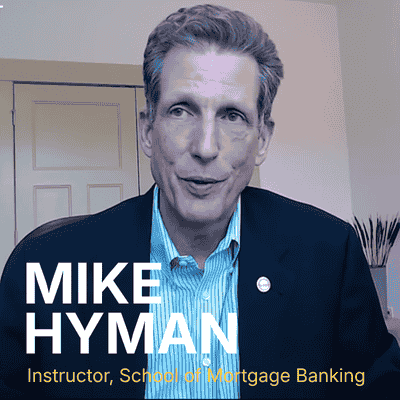
What Were We Thinking? 40 Years of Mortgage History with Mike Hyman
Show Notes
Go inside four decades of US mortgage history and learn how the industry evolved from 17% interest rates and paper-filled boxes to the dawn of AI. This episode offers a viewpoint from Mike Hyman, CMB. Mike is a true industry legend celebrating 30 years with the designation and 43 years in the trenches.
Mike takes you on a mind-bending journey, revealing what it was really like to work through the market's most transformative moments. He shares an unparalleled perspective from his time managing mortgage operations in the UK, uncovering key lessons for today's market.
In this episode, you will learn about:
-The Shocking 80s: How the industry functioned with 17% interest rates and manual, paper-based processes.
-The Rise of Innovation: The inside story on the birth of subservicing and reverse mortgages. Plus, experimentation with Negative Amortization loans. Even Fannie Mae had GPARM (graduated payment adjustable rate mortgage). Basically the trade off was lower payment upfront for larger payments later.
-Fannie vs. Freddie: The surprising cultural differences and political influence of the GSEs.
-Lessons from Abroad: Key insights from the UK's dynamic mortgage market that apply to the US today.
-Navigating Crisis: The real impact of the 2008 crash and the strategic shift to offshoring.
-The Crystal Ball: Provocative thoughts on the future of mortgages and the practices we might regret in 10 years.
Transcript
Val Buresch: Welcome back to CMBConnect, where we go behind the designation. I'm your host, Val Buresch. And today, we are doing something a little bit different. We are going to step into a time machine and journey through the last four decades of the mortgage industry. Our guide on this trip is someone many of you know, Mike Hyman.
From the days of manual originations in the early 80s to the birth of the private secondary market, to the dawn of reverse mortgages and even the rise of offshoring, Mike's career is a living biography of our industry. He also happens to be celebrating 30 years as a CMB this month, October 2025. Mike, it's an honor to have you. Thanks for joining us today.
Mike Hyman: My pleasure, Val. Thank you very much for having me. I appreciate it. As you said, 30 years of the CMB is kind of hard to believe. Here's a class of 1995 in San Diego, 30 years ago, October. So it's definitely something to celebrate.
Val Buresch: This is a wonderful picture. Please leave it for a moment because I want you to take us back to 1982 and paint a picture of the mortgage industry that you stepped into 43 years ago.
Mike Hyman: I'd be glad to. In 1982, if you think about it, was only maybe 10 years or so since the creation of Freddie Mac, the Equal Credit Opportunity Act, and the Community Reinvestment Act. In fact, it had only been maybe seven years earlier when married women could get a loan without their husband's approval. So there had been massive changes in just the previous few years, and mortgages could include restrictions however you wanted on who you actually sold the house to. Put that in perspective with incredibly high interest rates and inflation, and you get an idea of a very difficult time to start in that business.
In fact, we had the beginning of the securitizations at that time as well. This is an article from the New York Times in January 1982, and it shows that the interest rate that week of the 16th was 17.44%.
Val Buresch: 17.44%! Wow. And we are complaining about six and a half.
Mike Hyman: Yeah, you know, I don't feel that sorry when people complain six and a half or seven percent is really high. I'd like to point out this was where we were. The first rate sheet that I carried with me when I started had a 17% 30-year fixed-rate mortgage. Just as a point of interest, the highest the interest rates ever went for a 30-year fixed rate was over 18%, but it was quite something to start in that environment.
In fact, even years later, we talk about high interest rates. This is from March of 1991. One of my CMB colleagues, Ronwin Morrissey, was unpacking a box and found some newspaper she used to wrap up something and posted this. It showed how interest rates had fallen to as low as 12 and three-quarter percent by that point. But at the same time, you could buy a house in suburban Chicago for $69,900.
Val Buresch: Wow.
Mike Hyman: So that was really something. But we had other products that were introduced at that time to try to do something about the interest rate. ARM loans were brand new. We saw the introduction of adjustable-rate mortgages for the first time as a way to say to customers, "If you'll share some of the risk of interest rate movement, we can give you a much lower rate." We also saw experimentation with negative amortization loans at that time, because we all believed that housing values always went up. So what's the worst that could happen?
You even had Fannie Mae with a plan called 6A, which was a GPARM—graduated payment adjustable-rate mortgage—which had charged the interest rate here and gave the borrower a payment amount here. And it was supposed to be made up over five years by slowly increasing payments. Clearly, it didn't work out that way.
You still had Fannie Mae and Freddie Mac, but everything was incredibly manual. First thing, no internet, obviously, no web-based applications, and we didn't have automated underwriting yet. You'd find borrowers through some of the same ways you do now: through relationships with builders, developers, former customers. You might have a state housing agency program, a bond program, that lenders would be allowed to offer at a lower rate, say for first-time homeowners.
And you'd get your long-form 1003, the old one, which was a legal-size document, fill it out by hand, and then all of the processing was done manually by sending out confirmations. The interest rates were set by your secondary marketing department, typically once a day, somewhere mid-morning. So what that meant was that if you worked over the weekend, you had until about 10 o'clock Monday morning to lock your rates in at Friday's rate.
The processor would set the loan file up in this hard-shelled cardboard loan file with card dividers in them that had all the different pieces in there: the appraisal, credit report, verifications which were all paper-based. You wanted to verify someone's income, you had to mail a request to their employer and get it back through the mail.
Val Buresch: So that would take three, four days?
Mike Hyman: Yeah, that could take several days to get that back. Same thing for verification of employment. Once completed, the file would then be hand-delivered. You know, we use the word "handoff" now, but that term came from literally, I would hand you, the underwriter, a loan file and say, "This is now ready for underwriting." You would go through and look at every single page.
Val Buresch: So the technology was paper, a pen or maybe a typewriter, and a postage stamp for delivery of documents.
Mike Hyman: And typewriters, right. That's correct. You were always careful. You wanted to be sure it came through the mail to avoid any fraud situations. And underwriters at the time, for example, would look at the verification to see if it had any creases in the paper to make sure it had actually been put in an envelope. If it didn't, they might question it. So all these little tricks went into making sure that loan files were properly documented.
Val Buresch: So the way that the mortgages were designed and manufactured without the tools that we have today... it was very manual, but is the process the same as it is today, just with different tools?
Mike Hyman: The design really comes up with, as you would expect, what it takes to develop a product that customers will want to buy and that investors will need. The issue was, once you identified a potential customer, how did you qualify them? Well, we loan officers carried one of these qualifier calculators that you would use to figure out the PITI. It's a little thing like this that you would take with you, and you could speak to the customer and explain, "Here's what we think that you'll qualify for." Underwriting ratios were actually 28/36 for the most part for conventional conforming loans, with some ability to tweak that a bit—not the 45-50% that AUS allows today. It was pretty straightforward to say, "Here's your income, here's what you can afford," and then to proceed from there.
Val Buresch: How big was a loan file? How many pages did it have?
Mike Hyman: It would be pretty thick for a regular, salaried borrower. Obviously for a self-employed borrower, it would be significantly bigger. A lot of weight and a lot of paper.
You had to make sure that every page was in that file. Part of the reason that we went to no-documentation, no-verification later on is because we were coming out of this very manual process where you had to keep track of all these pages and documents, and people innovated and said, "Let's get rid of this."
Actually, two factors converged from different directions. One was the desire to ease the process, to make it easier. The other thing was, over time, we started getting better and better data on how these mortgages were performing. So you started saying, "Okay, a customer with these characteristics, most of the time, this loan is going to do just fine. We really don't need to go through all the steps we did before." And at the time, it seemed to make sense. With the ability of retroactive perspective, obviously, in our industry, we constantly are saying, "What were we thinking back then?"
Val Buresch: Well, just rounding out this part of your career, you have a degree in radio, TV, and motion pictures. I wanted to ask you, how did you end up in mortgages? And did that communications background give you a unique edge as a loan originator?
Mike Hyman: Well, first, I was sure I wanted to become a radio reporter. That was my goal—to be a broadcast journalist. That's where the degree started, but I also had an interest in real estate and then moved more into finance. You talk about skill sets, and I want to say this to everybody: very, very, very few people have anything resembling a mortgage banking degree when they get out of college.
One thing I've learned as a School of Mortgage Banking instructor, where I've had a chance to look up the backgrounds of the students, is that their experience comes from everywhere. A large number, in fact, come from food services, like servers and bartenders. You figure somebody that's dealing with difficult customers there can do well here. Similarly for me, the skill set I developed to put a microphone in your face and ask you some tough questions and get you to answer honestly is the same skill set needed to ask a prospective applicant, in a nice way, to explain their financial situation, even if it causes embarrassment.
Val Buresch: So all these experiences, we layer them as we go through life and leverage them as best we can. And I tend to agree with you; I haven't seen anybody who has a bachelor's in mortgage banking. There is no such degree.
Mike Hyman: No, and it's one of the strengths of our industry that we get people with such diverse backgrounds and experience. Because think about it, what skill sets are necessary as an originator, a processor, an underwriter, a closer? If you're sales-oriented, you like the public, you like being out there, we have sales. If you are very rules-based and you have a great ability to handle unstructured data, then processing. If you're an analyst and like making decisions, you have underwriting. If you're a phenomenal, maniacal project manager, then there's closing. There are all sorts of roles. So regardless of your background, if you're intrigued with the mortgage business, there is a place for you.
Val Buresch: Very well said. So back in time, the 80s, you entered the industry and the 1980s are roaring, so to speak. They're progressing and the entire mortgage market infrastructure is beginning to change. You are seeing now the entrance of private-label securitizers, and you ended up in secondary marketing, right?
Mike Hyman: I'm laughing because this was just before the private-label securitization. Secondary marketing at this time… I started with a whole loan secondary marketing firm. That whole function doesn't even exist now anymore. But at that time, loans other than those sold to Fannie Mae and Freddie Mac were sold on a whole-loan basis, particularly ARM loans and others. What would happen is someone would have a commitment they needed to fill, they didn't have enough loans, and they’d need to buy some from another lender. Or, a lender had extra loans left over they wanted to get rid of. There was no automated or online platform to do that.
So, whole-loan brokers like what I did... we had clients, both buyers and sellers, and we would match them up. And it was all done on a handshake over the phone. So, you'd call me and you'd say, "I've got $300,000 of 12.5% ARM loans that I have left over from my last commitment." And I'd say, "Hold on," I'd call a buyer and say, "I've got this at this price. Are you interested?" "Yes." Buy, sell, commit, done. And we would get a commission for the sale. That's how things were done for a long time.
Then I got started going to MBA conferences and other secondary market conferences. If I can, I wanted to say a word about what that actually entailed. In the first place, there were a lot of organizations that were offering secondary market conferences back then. You had the U.S. Savings and Loan League, you had the Eastern Secondary Conference, which was always in Raleigh, and you had the Western Secondary Conference, which still exists in a form, but back then it was always at the St. Francis Hotel in San Francisco on Union Square. Then you had the MBA Secondary Market conference, which wasn't planted in New York yet; it would move around.
And you had people, sellers of loans, who would bring a cardboard box full of loan files to show prospective buyers what their loans looked like so they could assess the quality and make a decision as to whether they wanted to buy loans from that particular source.
Val Buresch: Wait, wait, wait, just a second. So they brought the cardboard boxes into the conference?
Mike Hyman: Yeah, they brought them to the conference. You would go over in a corner and they would look through some of the loan files. "These look good. Yeah, we'll take them." And this is how some deals were done back then.
Val Buresch: It's so hard to imagine that from today's perspective.
Mike Hyman: It did. And you think for those of you working from home or in a very high-tech oriented office, imagine your clean desk. Well, this is what it looked like working back in the mid-1980s. You had all the papers on the wall that were the various lenders and what they were looking for, buying and selling loans. And that black thing just to the left of the picture, that is a Rolodex. Ask your grandparents about that. That’s how I kept track of my clients.
Val Buresch: So Fannie Mae was on Wisconsin Avenue, right? In DC all the time. Fun fact, my office is behind that building right now. Can you clarify or fill in my gaps there? How much did Fannie Mae and Freddie Mac influence the mortgage banking industry? Was it in the same way that they do now? I mean, it's 60-70% of mortgages are sold to those two agencies.
Mike Hyman: The influence, I always felt, went beyond market share to actual innovation. Everyone looked to Fannie Mae and Freddie Mac to improve the business. I would say it was a great thing, because it took much later for FinTech companies and software developers to really change our industry and bring in things like web-based and app-based applications. I think it was Rocket's predecessor, Quicken, that had the first fully web-enabled loan application.
Back then, the industry was nearly totally dependent on Fannie Mae and Freddie Mac for innovation. Between the two of them, they would come up with automated underwriting. At the time I was with EDS, and we actually developed the technology behind what was then called Loan Prospector. And then Fannie Mae followed very quickly with Desktop Underwriter (DU). And that was record-breaking, headline-grabbing news. "My gosh, there are not going to be any more human underwriters!" Of course, that's not what actually happened. It just meant underwriters could spend more time on loan files that needed human intervention, and companies could therefore close a lot more business.
The cultures were also very different. Anyone who ever went to Fannie Mae or Freddie Mac's office back then knew that Fannie Mae was inside the Beltway, very formal. You had to wear a tie and a suit when you went to their office. Their leadership was right out of the government. Franklin Raines, Clinton's OMB director, became president of Fannie Mae. So it was very politically oriented, I would say.
Whereas Freddie Mac over in McLean was laid-back. You would dress sort of like how I'm dressed now, and that was the dressiest you would get. You wouldn't dare show up at the Freddie Mac office wearing a tie.
At the MBA secondary market conferences, Freddie Mac and Fannie Mae had huge areas. You would go meet your customer rep, talk about various programs, and the rooms would have lots of meetings going on. And then for entertainment, Freddie Mac would be the more sedate. They would sponsor, say, a wine and cheese reception at a museum. Fannie Mae sponsored, I'm not kidding, the Rock and Roll Party. For years, at the secondary conference, Fannie Mae would sponsor a rock and roll party. It would be a big secret who was performing because it would be big-name groups—well, big names for back then like Kool & the Gang, the Four Tops, the Temptations. Val, put in your mind the image of a bunch of aging mortgage bankers getting down to 1970s music. I'll just tell you, I'm so glad they didn't have phones with video cameras back then.
Another fun fact: the current conforming loan amount for high-cost areas is now over a million dollars. In 1982, the conforming loan amount was $107,000, and that was for the lower 48 states, 50% higher for Alaska and Hawaii.
Val Buresch: Yeah, that's 10 times more now. Absolutely. Speaking of innovation, let's go back to the 1990s and stay there for a while. You saw the birth of subservicing. Can you talk a little bit about what was the core problem that this new, innovative solution was solving?
Mike Hyman: In the late 1980s, many, if not most, loans were done by savings and loans. These institutions had already had a rough time in the 80s because of all those long-term, fixed-rate mortgages they put on their portfolio that they didn't sell. And their cost of funds started going way up. When you have to pay 12% for a CD and you've got a whole bunch of 6-7% mortgages in your portfolio, it's not going to end well.
So subservicing started as a need for these institutions to cut costs in managing their customers. They wanted to put their focus on originating loans. As a subservicer, we would take care of the basic activities of servicing—customer service, investor reporting, escrow management, collections, foreclosure—all of those aspects that are a part of a servicer's responsibility, but at a fixed cost to enable them to focus on other things.
It was a small-time business until the collapse of the savings and loan industry and the creation of the Resolution Trust Corporation (RTC). When that happened, the few of us—it was Wendover Financial, the company I was with then, Litton Mortgage, Dovenmuehle—there were several early adopters in the subservicing business. Overnight, the RTC was saddled with tens of thousands of mortgages from failed institutions that needed to be managed.
We had 18-wheelers backing up to our office, dumping boxes of loan files. But remember, for everyone loading files into boxes, it was their last day at that bank, so the quality of the files we got was terrible. But very quickly, we had to scale up fast. We had to learn how to do master servicing when the RTC found that many California savings and loans were only buying 90% of the mortgages they purchased, leaving 10% and the actual servicing rights with the originator. So those of us that had those RTC contracts had to very quickly ramp up and learn how to deal with that.
Val Buresch: At the same time, we saw the dawn of the reverse mortgage business. I saw in your write-up that there was something called "50 loans for 50 lenders." Can you explain what this was?
Mike Hyman: The FHA version of reverse mortgages is called the HECM, Home Equity Conversion Mortgage. Back in the late 1980s, when FHA came up with this program, you had to remember there was a legal issue. Many states did not have the laws to support reverse mortgages because, as you may know, they pay out over time. So it took an act of Congress to create this product, and Congress created a demonstration program. The initial part was they allowed 50 lenders to do 50 loans each.
There was an initial meeting, and Jeff Taylor, one of my mentors, was at that meeting with his partner, Ken Austin. They looked around the room at the people that were going to be agreeing to do these loans and thought, "There's nobody here that can service these loans. The current systems won't handle it." So they walked around the room, handed out cards and said, "We can service these loans for you," and then ran back and actually built a rudimentary reverse mortgage servicing system.
So at that time in the early 1990s, Wendover Financial was the country's largest wholesaler and servicer of these FHA reverse mortgages, which were purchased by Fannie Mae. The initial feedback on reverse mortgages was not positive. This is from a 1996 Wall Street Journal article. I spent an hour on the phone with this reporter and I got like one sentence in the article quoted, just saying I think these are a good option. As you can see, the initial feeling was that it was only for a last resort and was incredibly expensive.
It took a while for the public to accept, wait a minute, half of the inquiries we're getting are from adult children. This is the first time you see a "sandwich generation" taking care of their children and, at the same time, trying to allow their parents to stay in their own home.
Val Buresch: So Mike, at the turn of the millennium, the early 2000s, your career took an international turn. You went to work in the mortgage industry, but in a different country. Can you take us back to that time?
Mike Hyman: Great. It was a monumental experience. In the early 2000s, a number of players in the US mortgage industry were starting to look beyond the US. There was a growing belief that what we were doing was exportable. The UK was one of the first to decide it wanted to start offering securitization and partnered with American companies that could provide support. The big one, the second largest mortgage lender in the UK, Abbey National, was interested in securitizing their very large portfolio of about a million and a half mortgages. They hired EDS, where I was working, to provide that support. And I was given the opportunity to move to England to lead the group that was putting together what would become a joint venture between EDS and Abbey National.
It was one of the largest third-party operations in the world. I got to work with a great team. We took over management of 1,500 staff from the bank and proceeded then to look at building relationships not only with other lenders in the UK, but also moving into Europe.
The experience of working in the UK was great. I had to learn a whole new vocabulary. We have checking accounts; they call them current accounts. We refinance loans; they call them remortgaging loans. They had more than 2,000 distinct loan products because you could tie a mortgage to a checking account or a life insurance policy. Their mortgages were also portable. So when you moved, you could take your old mortgage with you and just finance the balance if you needed to.
Val Buresch: So there is no involvement of the lender whatsoever?
Mike Hyman: Other than just a change of address and potentially increasing the loan amount. You think about it, England and Wales is like one big county. You have His Majesty's Land Title Registry. It's as if the entire US was one county, so it would make it much easier. We can't do that here because the minute you cross a county line, it's another recording office.
It was a lot of fun. I had a chance to go to Royal Ascot. Men had to wear a morning suit with striped trousers and a top hat; women had to wear hats. As I was walking around, I almost bumped into this lady who I understand was the owner of some of the horses. I was that close to her. No security, nobody else. For those of you who haven't picked up yet, that was the Queen.
Val Buresch: What an incredible experience! Did you have to move to the UK with your family?
Mike Hyman: Moved with my family and was there for four years. It was a very busy time. Much of that evaporated by 2008 when we had our own issues here. And that kind of segues into the next section. We all remember what happened, but I don't think many people understand the level of animosity from the public toward the mortgage banking industry.
What you see on your screen, that is the MBA annual convention in October 2011 at the Hyatt Regency in Chicago. You had all these groups like Occupy Wall Street and others who were continuing, even three years later, to shine a light on who they felt was the cause of all the grief. Here we are at the conference, looking out the window and seeing protesters protesting our industry. It was very sobering because I'd like to think that all of us in our industry were really intentional on trying to do the right thing. And yes, we had times that things we thought were right at the time turned out not to be, but that is a very sobering picture because we tend to forget that.
Val Buresch: I wanted to talk to you about offshoring because that was a big event, not only in mortgage banking but throughout the economy.
Mike Hyman: So let's first make sure we're talking about the same thing. There's a difference between outsourcing and offshoring. Outsourcing simply means taking over functions for another company. Offshoring means a company taking work and putting it somewhere far offshore.
In 2011, with the creation of those alphabet soup programs like HARP and TARP, there was a major turning point. For the first time, if you were a borrower who was paying your loan on time, but your loan amount was greater than the appraisal amount, you could now refinance your loan to lower the rate. We had one of the biggest explosions of refinances ever. People were on hold for one to two hours.
At the same time, the NMLS program had been created a few years earlier, but there weren't that many licensed loan officers. And remember the new rules: you couldn't take a loan application or discuss interest rates unless you had that NMLS license. It caused massive backlogs.
So one of the projects I worked on for one of the top five lenders, we created an origination operation in our office in the Philippines. We set it up so when people called, they got our call center. We set up a system that would ask five of the six questions required for a legal loan application. Then the agent would make sure that person really wanted a mortgage. They would do a warm transfer to a licensed loan officer at the bank in the US. And what they would get was a pre-qualified, ready-to-go customer. It was really successful because it cut hold time down to very little, and of course, the loan officers loved it.
Val Buresch: How did your time abroad change your view of the American mortgage industry when you came back?
Mike Hyman: One thing I realized very quickly... they didn't have 30-year fixed-rate mortgages. They would have 25-year amortization, maybe five-year fixed mortgages. The people in the UK were very fluent on their mortgages. Over there, everybody—receptionists, it didn't matter—had this knowledge because the terms were so short, it became conversational knowledge to see who had the best rate.
Here's the core difference, I think. We in the US create products and then we look for customers to buy those products. Those products are standardized, they have common underwriting, so we can get data on millions of comparable transactions and have a much more efficient market. In the UK and other markets, they would identify customers and then create the product that was ideal for that customer. In theory, that sounded great, but when you went to securitize a portfolio with more than 2,000 distinct types of mortgages, it was difficult.
I came back with the idea that there should be a balance. There should be a way that we can design products that really do fit a customer's particular need and still be able to find some efficiencies.
Val Buresch: With all your travels and changes, one of the constant things about your journey has been your involvement with the MBA, especially as an instructor at the School of Mortgage Banking. You even got the Faculty Fellow Award. What drives you to teach the next generation?
Mike Hyman: I've always been a big believer in the MBA as a means to help our industry be successful. The School of Mortgage Banking has a phenomenal way to introduce young people to the industry and give people that have been around a while a chance for a refresh and to establish relationships. I tell the people in the class that their fellow students might become a contact later when they have a question.
It gives a good grounding in how our business operates at a technical level. I've been teaching at the School of Mortgage Banking since the mid-1990s, on and off. And every new generation brings its own skills. By the way, if you know the Uniform Residential Loan Application (URLA) and you know what Section 8 is, that's the section of the loan application which requires a lender to ascertain the gender, ethnicity, and race of the borrower if they don't want to self-declare it. You can see with the younger people who have grown up in an ideal where you just don't ask questions like that, it's a bit of a shock. It takes some explaining that we've had so many bad judgments in our past, this is a way of holding ourselves accountable to ensure we do the right thing. It's not a means for discrimination; it's the opposite.
Val Buresch: Yeah, and that information from the URLA goes into the HMDA Loan/Application Register (LAR) reporting. Then HMDA data users like me, we model it, and it becomes a means for mortgage marketers to create better products and ensure there is a fit between the product they're offering and the community they're serving. That data should always be used for good.
Mike Hyman: I would love to see the day where you don't have to sign 25 documents to close the loan. But so many of those disclosures are there to make sure we don't make the mistakes we did in the past. As an industry, I really think we've done a good job at learning from those mistakes and putting protections in to ensure we don't do that again.
Val Buresch: We are coming to the end of our interview, and I want to express my sincere appreciation, Mike. What do you think is the next fundamental evolution for the mortgage banking industry that you see on the horizon?
Mike Hyman: At the core, it will always be the customer who wants to buy a home or reduce the cost of the home they already own. We will find ways to do that better. Artificial intelligence is the latest in a series of things that we think is going to blow up the industry. It will to an extent.
I've always believed in two things: when things are going really well, they will get worse, and when things are going really badly, they will get better. My message, particularly to people who do better in the good times, is save some of what you make because you'll need it later.
Ultimately, I see us in a position of starting to affect the customer in their whole holistic financial profile, where we are combining accounts, balancing other credit needs, and maybe even undoing this closed-credit mentality to allow people to borrow back funds on the loans they have started to pay down.
Val Buresch: As the industry changes, how must our designation, the Certified Mortgage Banker (CMB) designation, evolve to continue its value as the gold standard for expertise, knowledge, and ethics?
Mike Hyman: When someone told me when I got my CMB that this would be not an end but a touchpoint that would add kerosene to the fire, I didn't really see what that meant. Now it's been 30 years, and I'm still here. I would say to those who have it, or those thinking about it, it is a call to action and a commitment on your part to bring excellence, to continue to learn, to continue to innovate.
You are a team of spokespeople for the mortgage industry. That CMB designation gives you the credibility and the motivation to play an integral part in moving our industry forward.
And the last thing I'll say, Val, if I could have a crystal ball and ask it one question, I'd love to know: 10 years from now, what are we doing today that we will decide was not the right thing to do? Because there's always been a point in the past that we look back and say, "We need to fix that." Somebody watching this video in 2035 can look back and laugh and say, "Boy, they had no idea, did they?"
Val Buresch: That's right. Well, Mike, this is a thought-provoking question and a perfect note to end our conversation. It was a real gift to have your time and your wisdom. I can't thank you enough for taking us on this journey.
Mike Hyman: And I feel old, but thank you for that.
Val Buresch: No, you're not. And I want to congratulate you one more time on the 30th anniversary of your CMB. To relate to one of your photos, you are CMB royalty.
Mike Hyman: Thank you, Val. It's been a pleasure.
Val Buresch: For our listeners who were inspired by our conversation today, where is the best place for them to find you?
Mike Hyman: Just search for me on LinkedIn, Mike Hyman, CMB. It's probably the easiest way to find me.
Val Buresch: That's great. I'll drop your handle in the notes. And to everyone listening, if you enjoyed this deep dive into the mortgage industry, please make sure to subscribe to CMBConnect and follow us. I'm your host, Val Buresch, and this is the CMBConnect Podcast, where we go behind the designation.
