Articles
5 minutes

Agency Adjustable-Rate Mortgages Are Back: What the 2026 Data Shows
June 24, 2026
thumbnail with polygon research logo upper left - agency ARMs trends 2026
Author:
Val Buresch, CMB

Agency adjustable-rate mortgages (ARMs) are returning to relevance in a mortgage market defined by elevated rates, high home prices and continued affordability pressure.

Agency ARM market share increased from 0.31% in 2021 to 3.34% YTD 2026. Independent mortgage banks (IMBs) now occupy every position among the 10 largest agency ARM seller/issuers. The borrowers using these loans have also changed: average credit scores are lower, while leverage and debt-to-income ratios are considerably higher.

These shifts tell a larger story about who is bringing ARMs to market, who is using them and the role adjustable-rate mortgages are beginning to play in today’s housing finance system.

Data source: Polygon Research, Polygon Pulse (MBS Pivot). The analysis covers agency loans represented in Fannie Mae, Freddie Mac and Ginnie Mae mortgage-backed securities data. Seller/issuer rankings are based on ARM loan count. YTD 2026 data is through May 2026.

Agency ARM trends in 2026

Three findings define the current agency ARM market:

  1. Agency ARM market share rose from 0.31% in 2021 to 3.34% YTD 2026, an increase of ten times.
  2. IMBs hold all 10 positions among the leading agency ARM seller/issuers in YTD 2026.
  3. Compared with the 2021 cohort, the average YTD 2026 agency ARM borrower has a lower FICO score, higher LTV and higher DTI.

Agency ARMs remain a relatively small part of the overall market. Their position within the agency product mix has changed substantially.

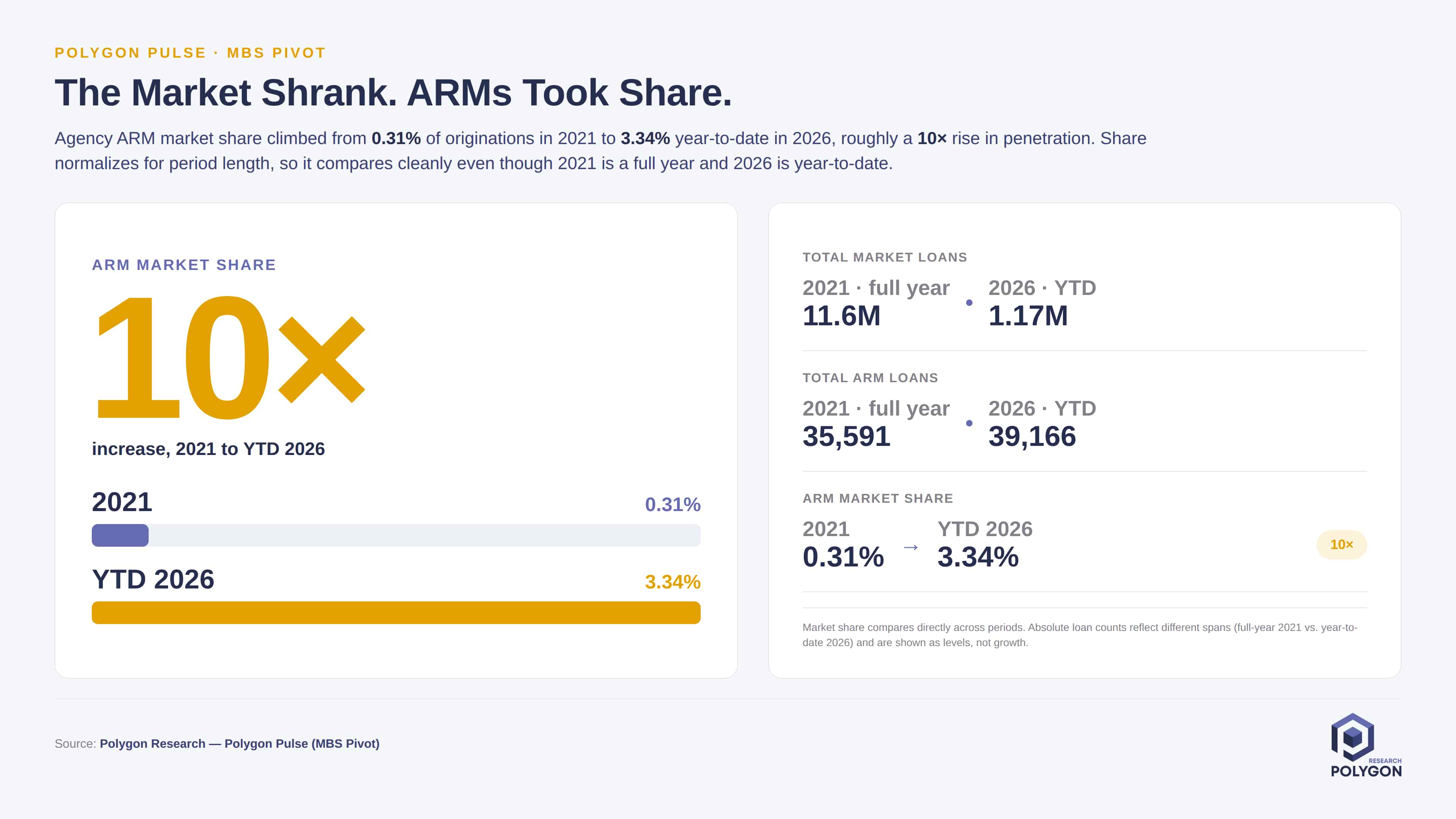
Agency ARM share increased nearly tenfold, rising from 0.31% in 2021 to 3.34% YTD 2026.
Download the Agency ARMs Market Share Chart.

Agency ARMs accounted for just 0.31% of agency mortgage loans in 2021. By YTD 2026, their share had climbed to 3.34%.

The shift is especially notable because the mortgage environment is very different from the low-rate market of 2021. Borrowers now face a combination of higher monthly payments and home prices that remain elevated in many markets.

An adjustable-rate mortgage may offer a lower initial interest rate than a comparable fixed-rate mortgage, depending on pricing and loan terms. That lower starting rate can reduce the initial payment, improve qualification or allow a borrower to preserve more monthly cash flow.

The increase in market share shows a trend of ARMs gaining relevance as lenders and borrowers look for ways to manage the initial cost of homeownership.

ARM usage also varies widely by geography. Our earlier state-level adjustable-rate mortgage analysis found greater ARM penetration in several expensive housing markets where the difference between fixed and adjustable rates can have a larger effect on the monthly payment.
The ARM comeback revives a familiar debate

The renewed use of adjustable-rate mortgages brings back a debate that was already underway before the housing crisis.

In February 2004, Federal Reserve Chairman Alan Greenspan argued that many homeowners might have saved tens of thousands of dollars by choosing adjustable-rate mortgages rather than fixed-rate loans during the preceding decade.

His reasoning was straightforward. A 30-year fixed-rate borrower pays for long-term payment certainty and protection from rising interest rates. Borrowers with the capacity to manage interest-rate risk could potentially avoid some of that cost by choosing an ARM.

Greenspan also recognized the limitation of the argument. Those savings would have looked very different if interest rates had risen sharply.

By July 2005, his tone had become more cautious. Greenspan identified the rising prevalence of interest-only loans and more exotic adjustable-rate mortgage structures as a particular concern, even while acknowledging that such products could have appropriate uses.

That progression captures the central tension surrounding ARMs.

A lower initial rate can help a borrower manage the cost of purchasing a home. The borrower’s leverage, debt obligations, product terms and ability to absorb a future payment increase determine how much risk accompanies that benefit.

Today’s agency ARMs differ from the option ARMs and private-label products associated with the years before the financial crisis. The loans in this analysis entered Fannie Mae, Freddie Mac or Ginnie Mae securities and operate within current agency and government mortgage frameworks.

The historical lesson remains relevant: the value of an ARM depends on more than the starting rate. The borrower’s financial cushion and the structure of the loan matter just as much.

Independent mortgage banks have taken over the agency ARM rankings

Top 10 agency ARM seller-issuers in 2021 and YTD 2026, showing five depository banks in the 2021 rankings and independent mortgage banks in all 10 positions in 2026.
IMBs occupy every top-10 agency ARM seller/issuer position in YTD 2026. Five banks appeared in the 2021 ranking.

The institutions leading the agency ARM market have changed dramatically since 2021. Five banks appeared among the 10 largest agency ARM seller/issuers in 2021:

  • Wells Fargo Bank
  • JPMorgan Chase Bank
  • Truist Bank
  • Citizens Bank
  • U.S. Bank

Wells Fargo led the market with 6,013 agency ARMs. By YTD 2026, no depository institution remained in the top 10. Every position was held by an independent mortgage bank or other non-depository mortgage company.

Who are the top agency ARM lenders in 2026?

The leading agency ARM seller/issuers in YTD 2026 are:

  1. PennyMac Loan Services: 4,675 loans
  2. United Wholesale Mortgage: 3,786
  3. Freedom Mortgage Corp.: 3,283
  4. Rocket Mortgage:** 2,887
  5. Lakeview Loan Servicing: 2,605
  6. Planet Home Lending: 1,489
  7. Nationstar (Mr. Cooper): 1,349
  8. CrossCountry Mortgage: 1,179
  9. CMG Mortgage, Inc.: 1,061
  10. DHI Mortgage Company: 1,012
Download the Agency ARM Lender Rankings Chart.

The change reflects a broader transformation in agency mortgage production and distribution.

Many IMBs operate across retail, wholesale and correspondent channels. Their centralized product, pricing and distribution capabilities can help them respond quickly when a product becomes more relevant to originators and borrowers.

The YTD 2026 rankings show that IMBs have become the principal institutions bringing adjustable-rate mortgages into the agency secondary market.

For banks and credit unions, the rankings provide a competitive signal. ARM demand has not disappeared. Much of the current activity has shifted toward nonbank lenders that have incorporated the product into their broader affordability and origination strategies.

The agency ARM borrower has become more stretched
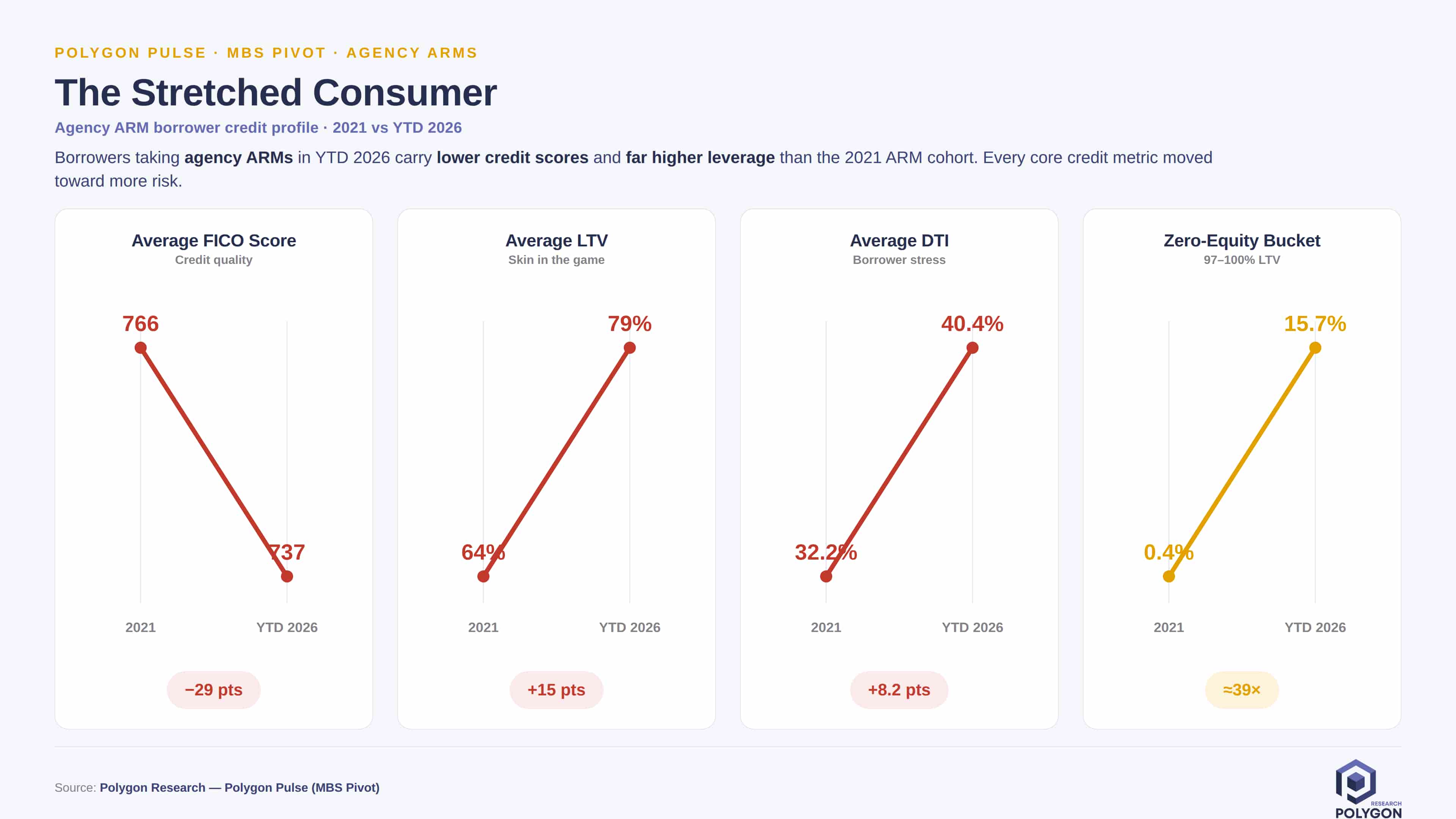
Agency ARM borrower profile comparison showing average FICO declining from 766 to 737, average LTV rising from 64% to 79%, average DTI increasing from 32.2% to 40.4%, and the 97% to 100% LTV share rising from 0.4% to 15.7%.
Compared with 2021, YTD 2026 agency ARM borrowers have lower average credit scores, higher leverage and higher debt-to-income ratios.

The change in lender leadership is significant. The change in the borrower profile may be even more consequential. Across four core credit measures, the YTD 2026 agency ARM borrower has less financial cushion than the 2021 borrower.

Download the Agency ARM Borrower Credit Profile

Average FICO declined from 766 to 737

The average FICO score for an agency ARM borrower fell by 29 points between 2021 and YTD 2026.

An average score of 737 still reflects a generally strong credit profile. The decline shows that agency ARM usage has expanded beyond the exceptionally high-credit borrower population represented in the 2021 data.

Average LTV increased from 64% to 79%

The average loan-to-value ratio increased by 15 percentage points.

The average 2021 borrower entered with approximately 36% equity. The average YTD 2026 borrower entered with approximately 21%.

The current borrower therefore has a smaller equity cushion at origination.

Average DTI increased from 32.2% to 40.4%

Average debt-to-income ratio rose by 8.2 percentage points.

The change indicates that current ARM borrowers are committing a greater portion of their monthly income to debt obligations. It also supports the view that the lower initial payment is becoming more important in borrower qualification and product selection.

The 97%–100% LTV segment rose from 0.4% to 15.7%

The largest shift appears among borrowers entering the mortgage market with little or no equity.

In 2021, only 0.4% of agency ARMs had LTV ratios between 97% and 100%. In YTD 2026, that share reached 15.7%.

The proportion is approximately 39 times higher than it was in 2021.

High LTV does not determine whether a loan will perform. It does reduce the borrower’s initial equity cushion. When high leverage is combined with a higher DTI and the possibility of a future rate adjustment, the loan deserves closer monitoring.

What is driving the return of agency ARMs?

The data points to three connected forces.

1) Affordability pressure

Elevated rates and home prices have increased the monthly cost of purchasing a home. A lower initial ARM rate can improve qualification or reduce the early payment burden.

For some borrowers, the decision may rest on an expectation that they will refinance, sell the property or increase their income before the first adjustment. Each of those outcomes carries uncertainty.

2) IMB product and distribution capacity

Independent mortgage banks have taken the leading positions in agency ARM production.

Their presence across multiple origination channels can help them introduce ARM products quickly, reach a broad set of loan officers and brokers, and respond to changes in borrower demand.

3) A broader ARM borrower population

The movement in FICO, LTV and DTI shows that agency ARM usage has expanded into a more leveraged segment of the market.

ARMs appear to be serving more borrowers for whom the initial payment carries considerable weight in the mortgage decision.

Are today’s agency ARMs the same as pre-crisis ARMs?

Today’s agency ARM market should not be equated with the full range of nontraditional mortgage products offered before the financial crisis.

The loans covered in this analysis entered agency or government mortgage-backed securities. They are distinct from the private-label option ARMs, negative-amortization products and loosely underwritten loans frequently associated with the pre-crisis market.

Product structure still matters.

ARM borrowers and loan officers should understand:

  • The length of the initial fixed-rate period
  • The index used to calculate future adjustments
  • The lender’s margin
  • Initial, periodic and lifetime rate caps
  • How often the rate can adjust
  • The maximum possible payment
  • Whether the borrower could sustain the payment after an adjustment

The current credit profile adds another layer to that evaluation. Compared with 2021, today’s agency ARM borrowers have higher leverage, greater debt burdens and less equity protection.

What should mortgage lenders watch?

ARM activity by borrower segment

Lenders should examine ARM production by FICO, LTV, DTI, geography, loan purpose, loan type, occupancy and channel.

Averages provide a directional view. The concentration of loans across several risk characteristics can reveal more than any single measure.

Borrower education and disclosure

Borrowers need a clear explanation of how the loan can change after the introductory period. The discussion should cover the initial rate, adjustment schedule, index, margin, caps and possible future payment. A borrower choosing an ARM to solve an immediate affordability problem also needs to understand the longer-term obligation.

Competitive positioning

Banks and credit unions should evaluate why IMBs now dominate the top agency ARM rankings. Useful questions include:

  • Which lenders are gaining ARM production?
  • Which channels are driving the volume?
  • Where are the loans concentrated geographically?
  • What borrower profiles are being served?
  • How does ARM pricing compare with fixed-rate alternatives?

Loan performance

The charts in this analysis describe origination characteristics. They do not measure delinquency, default, prepayment or long-term borrower outcomes. The shift toward lower FICO, higher LTV and higher DTI is an early credit-profile signal. Performance analysis will show whether that movement translates into different outcomes over time.

A product opportunity and a developing market signal

The agency ARM market has entered a different phase.

ARM share has increased tenfold since 2021. IMBs now hold every position among the 10 largest agency ARM seller/issuers. The average borrower has a lower credit score, higher leverage and a higher debt-to-income ratio.

These findings do not establish that an ARM is unsuitable for a particular borrower. They show that ARMs are increasingly being used in circumstances where affordability, qualification and financial flexibility carry more weight.

For lenders, that creates a product opportunity. It also increases the importance of underwriting, borrower education, product design and performance monitoring.

The agency ARM comeback deserves attention because of who is leading it and who is borrowing.

Explore agency ARM production by lender, geography, loan purpose, channel and borrower profile in MBS Pivot, Polygon Research’s loan-level agency mortgage intelligence platform.

Articles
Val Buresch, CMB
5 minutes

Agency Adjustable-Rate Mortgages Are Back: What the 2026 Data Shows

Published
June 24, 2026
Updated
June 24, 2026

Agency ARM share rose from 0.31% in 2021 to 3.34% YTD 2026. See which lenders lead and how borrower FICO, LTV and DTI have shifted.

thumbnail with polygon research logo upper left - agency ARMs trends 2026

Agency adjustable-rate mortgages (ARMs) are returning to relevance in a mortgage market defined by elevated rates, high home prices and continued affordability pressure.

Agency ARM market share increased from 0.31% in 2021 to 3.34% YTD 2026. Independent mortgage banks (IMBs) now occupy every position among the 10 largest agency ARM seller/issuers. The borrowers using these loans have also changed: average credit scores are lower, while leverage and debt-to-income ratios are considerably higher.

These shifts tell a larger story about who is bringing ARMs to market, who is using them and the role adjustable-rate mortgages are beginning to play in today’s housing finance system.

Data source: Polygon Research, Polygon Pulse (MBS Pivot). The analysis covers agency loans represented in Fannie Mae, Freddie Mac and Ginnie Mae mortgage-backed securities data. Seller/issuer rankings are based on ARM loan count. YTD 2026 data is through May 2026.

Agency ARM trends in 2026

Three findings define the current agency ARM market:

  1. Agency ARM market share rose from 0.31% in 2021 to 3.34% YTD 2026, an increase of ten times.
  2. IMBs hold all 10 positions among the leading agency ARM seller/issuers in YTD 2026.
  3. Compared with the 2021 cohort, the average YTD 2026 agency ARM borrower has a lower FICO score, higher LTV and higher DTI.

Agency ARMs remain a relatively small part of the overall market. Their position within the agency product mix has changed substantially.

Agency ARM share increased nearly tenfold, rising from 0.31% in 2021 to 3.34% YTD 2026.
Download the Agency ARMs Market Share Chart.

Agency ARMs accounted for just 0.31% of agency mortgage loans in 2021. By YTD 2026, their share had climbed to 3.34%.

The shift is especially notable because the mortgage environment is very different from the low-rate market of 2021. Borrowers now face a combination of higher monthly payments and home prices that remain elevated in many markets.

An adjustable-rate mortgage may offer a lower initial interest rate than a comparable fixed-rate mortgage, depending on pricing and loan terms. That lower starting rate can reduce the initial payment, improve qualification or allow a borrower to preserve more monthly cash flow.

The increase in market share shows a trend of ARMs gaining relevance as lenders and borrowers look for ways to manage the initial cost of homeownership.

ARM usage also varies widely by geography. Our earlier state-level adjustable-rate mortgage analysis found greater ARM penetration in several expensive housing markets where the difference between fixed and adjustable rates can have a larger effect on the monthly payment.

The ARM comeback revives a familiar debate

The renewed use of adjustable-rate mortgages brings back a debate that was already underway before the housing crisis.

In February 2004, Federal Reserve Chairman Alan Greenspan argued that many homeowners might have saved tens of thousands of dollars by choosing adjustable-rate mortgages rather than fixed-rate loans during the preceding decade.

His reasoning was straightforward. A 30-year fixed-rate borrower pays for long-term payment certainty and protection from rising interest rates. Borrowers with the capacity to manage interest-rate risk could potentially avoid some of that cost by choosing an ARM.

Greenspan also recognized the limitation of the argument. Those savings would have looked very different if interest rates had risen sharply.

By July 2005, his tone had become more cautious. Greenspan identified the rising prevalence of interest-only loans and more exotic adjustable-rate mortgage structures as a particular concern, even while acknowledging that such products could have appropriate uses.

That progression captures the central tension surrounding ARMs.

A lower initial rate can help a borrower manage the cost of purchasing a home. The borrower’s leverage, debt obligations, product terms and ability to absorb a future payment increase determine how much risk accompanies that benefit.

Today’s agency ARMs differ from the option ARMs and private-label products associated with the years before the financial crisis. The loans in this analysis entered Fannie Mae, Freddie Mac or Ginnie Mae securities and operate within current agency and government mortgage frameworks.

The historical lesson remains relevant: the value of an ARM depends on more than the starting rate. The borrower’s financial cushion and the structure of the loan matter just as much.

Independent mortgage banks have taken over the agency ARM rankings

Top 10 agency ARM seller-issuers in 2021 and YTD 2026, showing five depository banks in the 2021 rankings and independent mortgage banks in all 10 positions in 2026.
IMBs occupy every top-10 agency ARM seller/issuer position in YTD 2026. Five banks appeared in the 2021 ranking.

The institutions leading the agency ARM market have changed dramatically since 2021. Five banks appeared among the 10 largest agency ARM seller/issuers in 2021:

  • Wells Fargo Bank
  • JPMorgan Chase Bank
  • Truist Bank
  • Citizens Bank
  • U.S. Bank

Wells Fargo led the market with 6,013 agency ARMs. By YTD 2026, no depository institution remained in the top 10. Every position was held by an independent mortgage bank or other non-depository mortgage company.

Who are the top agency ARM lenders in 2026?

The leading agency ARM seller/issuers in YTD 2026 are:

  1. PennyMac Loan Services: 4,675 loans
  2. United Wholesale Mortgage: 3,786
  3. Freedom Mortgage Corp.: 3,283
  4. Rocket Mortgage:** 2,887
  5. Lakeview Loan Servicing: 2,605
  6. Planet Home Lending: 1,489
  7. Nationstar (Mr. Cooper): 1,349
  8. CrossCountry Mortgage: 1,179
  9. CMG Mortgage, Inc.: 1,061
  10. DHI Mortgage Company: 1,012
Download the Agency ARM Lender Rankings Chart.

The change reflects a broader transformation in agency mortgage production and distribution.

Many IMBs operate across retail, wholesale and correspondent channels. Their centralized product, pricing and distribution capabilities can help them respond quickly when a product becomes more relevant to originators and borrowers.

The YTD 2026 rankings show that IMBs have become the principal institutions bringing adjustable-rate mortgages into the agency secondary market.

For banks and credit unions, the rankings provide a competitive signal. ARM demand has not disappeared. Much of the current activity has shifted toward nonbank lenders that have incorporated the product into their broader affordability and origination strategies.

The agency ARM borrower has become more stretched

Agency ARM borrower profile comparison showing average FICO declining from 766 to 737, average LTV rising from 64% to 79%, average DTI increasing from 32.2% to 40.4%, and the 97% to 100% LTV share rising from 0.4% to 15.7%.
Compared with 2021, YTD 2026 agency ARM borrowers have lower average credit scores, higher leverage and higher debt-to-income ratios.

The change in lender leadership is significant. The change in the borrower profile may be even more consequential. Across four core credit measures, the YTD 2026 agency ARM borrower has less financial cushion than the 2021 borrower.

Download the Agency ARM Borrower Credit Profile

Average FICO declined from 766 to 737

The average FICO score for an agency ARM borrower fell by 29 points between 2021 and YTD 2026.

An average score of 737 still reflects a generally strong credit profile. The decline shows that agency ARM usage has expanded beyond the exceptionally high-credit borrower population represented in the 2021 data.

Average LTV increased from 64% to 79%

The average loan-to-value ratio increased by 15 percentage points.

The average 2021 borrower entered with approximately 36% equity. The average YTD 2026 borrower entered with approximately 21%.

The current borrower therefore has a smaller equity cushion at origination.

Average DTI increased from 32.2% to 40.4%

Average debt-to-income ratio rose by 8.2 percentage points.

The change indicates that current ARM borrowers are committing a greater portion of their monthly income to debt obligations. It also supports the view that the lower initial payment is becoming more important in borrower qualification and product selection.

The 97%–100% LTV segment rose from 0.4% to 15.7%

The largest shift appears among borrowers entering the mortgage market with little or no equity.

In 2021, only 0.4% of agency ARMs had LTV ratios between 97% and 100%. In YTD 2026, that share reached 15.7%.

The proportion is approximately 39 times higher than it was in 2021.

High LTV does not determine whether a loan will perform. It does reduce the borrower’s initial equity cushion. When high leverage is combined with a higher DTI and the possibility of a future rate adjustment, the loan deserves closer monitoring.

What is driving the return of agency ARMs?

The data points to three connected forces.

1) Affordability pressure

Elevated rates and home prices have increased the monthly cost of purchasing a home. A lower initial ARM rate can improve qualification or reduce the early payment burden.

For some borrowers, the decision may rest on an expectation that they will refinance, sell the property or increase their income before the first adjustment. Each of those outcomes carries uncertainty.

2) IMB product and distribution capacity

Independent mortgage banks have taken the leading positions in agency ARM production.

Their presence across multiple origination channels can help them introduce ARM products quickly, reach a broad set of loan officers and brokers, and respond to changes in borrower demand.

3) A broader ARM borrower population

The movement in FICO, LTV and DTI shows that agency ARM usage has expanded into a more leveraged segment of the market.

ARMs appear to be serving more borrowers for whom the initial payment carries considerable weight in the mortgage decision.

Are today’s agency ARMs the same as pre-crisis ARMs?

Today’s agency ARM market should not be equated with the full range of nontraditional mortgage products offered before the financial crisis.

The loans covered in this analysis entered agency or government mortgage-backed securities. They are distinct from the private-label option ARMs, negative-amortization products and loosely underwritten loans frequently associated with the pre-crisis market.

Product structure still matters.

ARM borrowers and loan officers should understand:

  • The length of the initial fixed-rate period
  • The index used to calculate future adjustments
  • The lender’s margin
  • Initial, periodic and lifetime rate caps
  • How often the rate can adjust
  • The maximum possible payment
  • Whether the borrower could sustain the payment after an adjustment

The current credit profile adds another layer to that evaluation. Compared with 2021, today’s agency ARM borrowers have higher leverage, greater debt burdens and less equity protection.

What should mortgage lenders watch?

ARM activity by borrower segment

Lenders should examine ARM production by FICO, LTV, DTI, geography, loan purpose, loan type, occupancy and channel.

Averages provide a directional view. The concentration of loans across several risk characteristics can reveal more than any single measure.

Borrower education and disclosure

Borrowers need a clear explanation of how the loan can change after the introductory period. The discussion should cover the initial rate, adjustment schedule, index, margin, caps and possible future payment. A borrower choosing an ARM to solve an immediate affordability problem also needs to understand the longer-term obligation.

Competitive positioning

Banks and credit unions should evaluate why IMBs now dominate the top agency ARM rankings. Useful questions include:

  • Which lenders are gaining ARM production?
  • Which channels are driving the volume?
  • Where are the loans concentrated geographically?
  • What borrower profiles are being served?
  • How does ARM pricing compare with fixed-rate alternatives?

Loan performance

The charts in this analysis describe origination characteristics. They do not measure delinquency, default, prepayment or long-term borrower outcomes. The shift toward lower FICO, higher LTV and higher DTI is an early credit-profile signal. Performance analysis will show whether that movement translates into different outcomes over time.

A product opportunity and a developing market signal

The agency ARM market has entered a different phase.

ARM share has increased tenfold since 2021. IMBs now hold every position among the 10 largest agency ARM seller/issuers. The average borrower has a lower credit score, higher leverage and a higher debt-to-income ratio.

These findings do not establish that an ARM is unsuitable for a particular borrower. They show that ARMs are increasingly being used in circumstances where affordability, qualification and financial flexibility carry more weight.

For lenders, that creates a product opportunity. It also increases the importance of underwriting, borrower education, product design and performance monitoring.

The agency ARM comeback deserves attention because of who is leading it and who is borrowing.

Explore agency ARM production by lender, geography, loan purpose, channel and borrower profile in MBS Pivot, Polygon Research’s loan-level agency mortgage intelligence platform.

Frequently Asked Questions

Are adjustable-rate mortgages gaining market share in 2026?

Yes. Agency ARM market share increased from 0.31% in 2021 to 3.34% YTD 2026. That represents an increase of ten times, although ARMs still account for a minority of total agency mortgage originations.

Icon - Elements Webflow Library - BRIX Templates

Who is the largest agency ARM lender in 2026?

PennyMac Loan Services ranked first among agency ARM seller/issuers in YTD 2026, with 4,675 loans during the period analyzed.

Icon - Elements Webflow Library - BRIX Templates

Are today’s agency ARMs the same as the ARMs offered before the financial crisis?

Today’s agency ARM market differs from the private-label option ARMs and other exotic mortgage products associated with the pre-crisis period. The loans analyzed here entered Fannie Mae, Freddie Mac or Ginnie Mae securities. Borrower leverage, DTI, product terms and future payment exposure still require careful evaluation.

Icon - Elements Webflow Library - BRIX Templates

How can lenders analyze ARM production in their markets?

MBS Pivot allows mortgage professionals to examine agency ARM activity by seller/issuer, geography, agency, channel, loan purpose, FICO, LTV, DTI and other loan characteristics.

Icon - Elements Webflow Library - BRIX Templates

Explore Mortgage Market Intelligence in Practice

See how Polygon helps teams grow through insight.